$200-$250/mo for a chatbot?

For the last two years, we got used to "flat-rate intelligence"—access to the smartest models for the price of a few coffees. That $20 price point established a psychological baseline. Now, with the release of OpenAI’s ChatGPT 5.2 Pro ($200/mo) and Google’s Gemini 3 Ultra (~$250/mo), we are shattering that ceiling and entering an economy of "super-premium" tools. (I am not personally a Claude fan but they too have Claude Max for $100-$200/mo).
It’s a steep hike—a tenfold increase—but in our work deploying these systems, the difference in capability is real.
The decision on which path to take depends entirely on what problem is slowing your team down. Here is what we are seeing in the field and how to think about the ROI for your organizations.
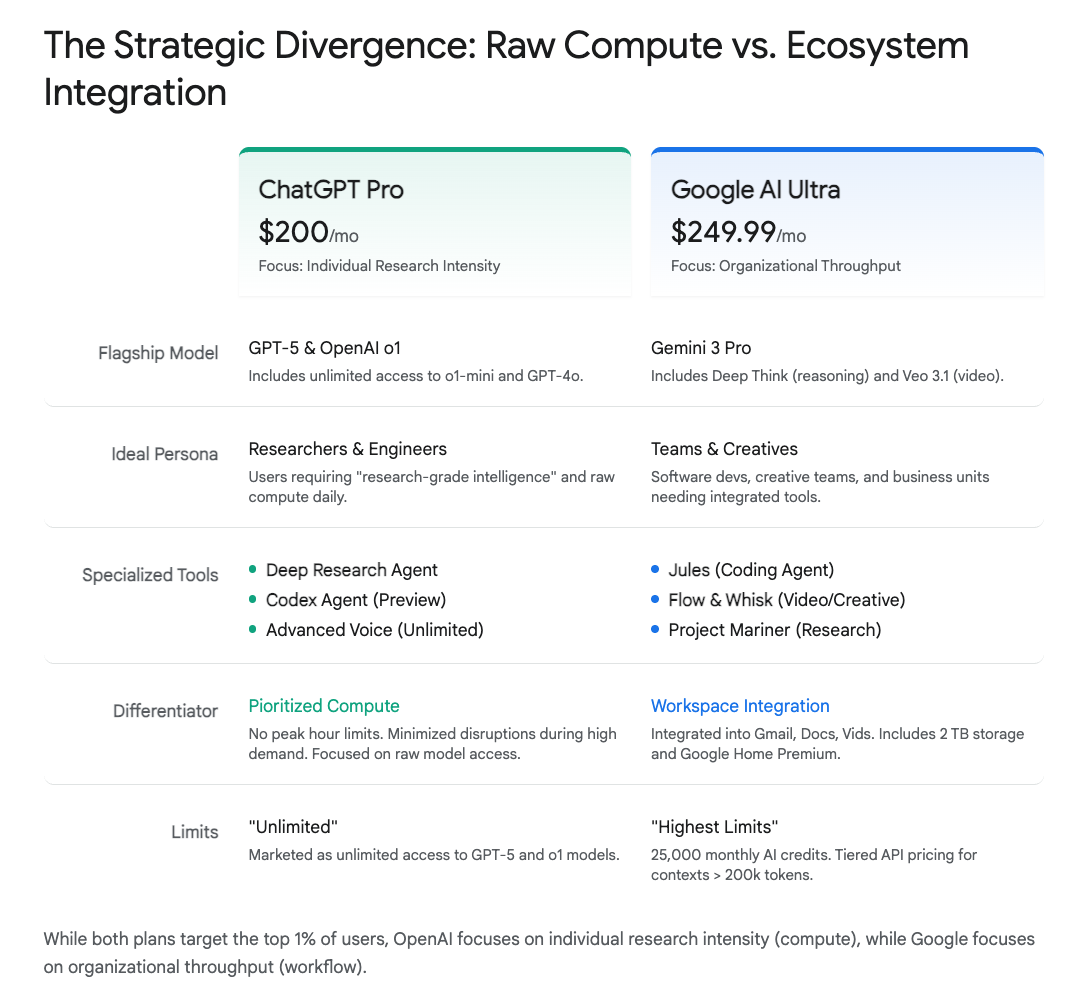
The Split: Deep Logic vs. Massive Workflow
The market has split into two very different philosophies. You aren't just buying a chatbot anymore; you are leasing a specific type of capability.
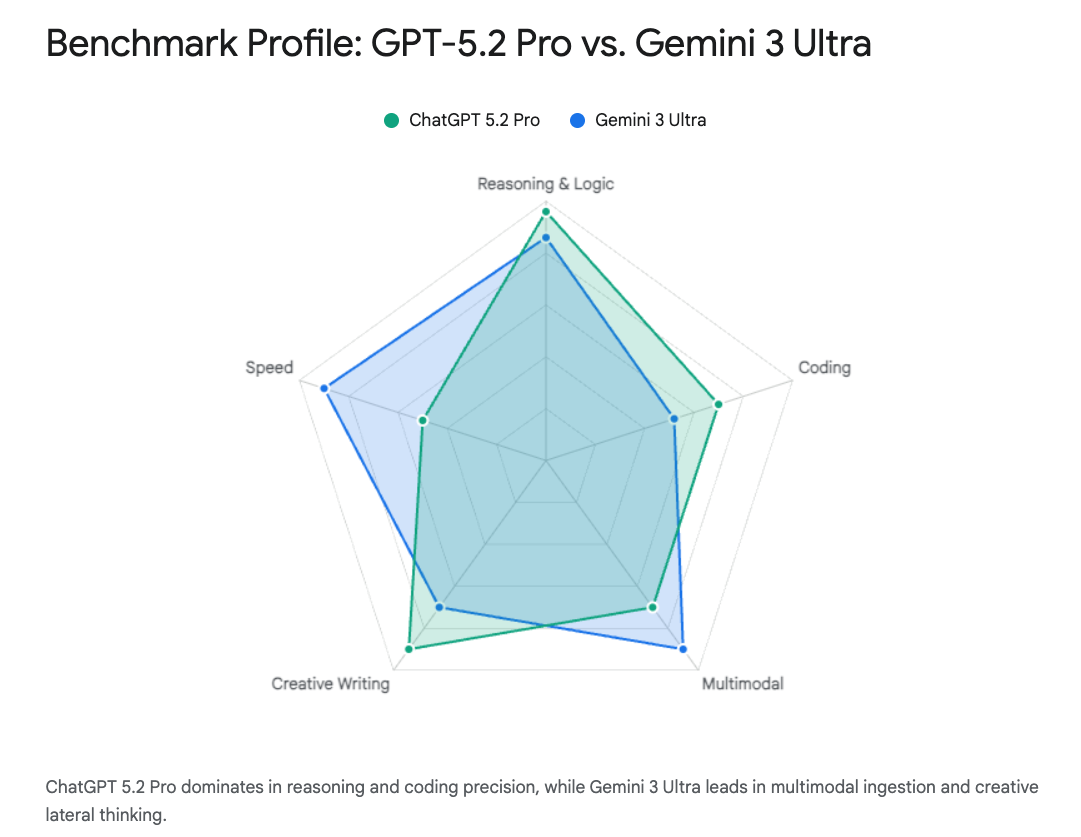
1. The Deep Thinker: ChatGPT 5.2 Pro ($200/mo)
OpenAI is betting heavily on "System 2" thinking—a concept from psychology where the brain pauses to deliberate and plan before acting. When you subscribe to their new o1 pro mode, you are effectively paying for a "compute lease."
Unlike standard models that instinctually predict the next word (System 1), the o1 Pro architecture generates hidden "chains of thought." It verifies its own logic, explores alternative solution paths, and backtracks when it hits a dead end. This process is computationally expensive, which drives the cost.
- Who it’s for: Your "lone wolf" experts—senior engineers, data scientists, legal researchers, or academics.
- The "So What": If your bottleneck is depth and logic—debugging a complex kernel driver, drafting a watertight legal precedent, or crunching advanced differential equations—this is the tool. The "thinking time" (the pause while it reasons) is a feature, not a bug. It grinds through problems that make standard models give up or hallucinate.
2. The Office Powerhouse: Gemini 3 Ultra (~$250/mo)
Google is taking a different approach. They aren't selling raw compute as much as an "ecosystem lease." The value here is the massive "context window"—the ability to ingest up to 1 million tokens of information at once.
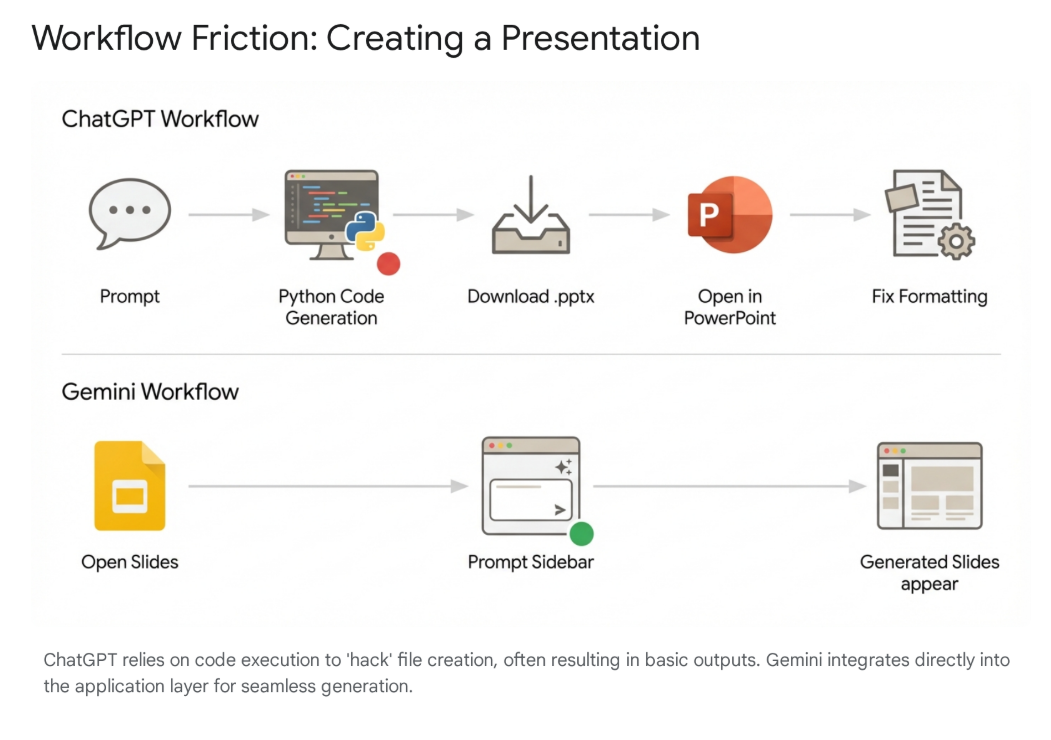
Where ChatGPT scripts document creation from the outside (often relying on Python scripts to generate files), Gemini lives inside your documents. It solves the "last mile" problem of workflow integration.
- Who it’s for: Your organizational hubs—Product Managers, Marketing VPs, and CEOs.
- The "So What": If your bottleneck is breadth and workflow—synthesizing 50 documents into a strategy, turning a one-hour meeting video into a slide deck, or managing a massive project—Gemini wins. You can upload an entire codebase, a library of manuals, and a video of a bug report, and it understands them all simultaneously. It removes the friction of context switching.
The "Deep Research" Battle: Autonomous Agent vs. Structured Analyst
Both platforms have launched "Deep Research" capabilities designed to go beyond simple search queries, browsing dozens of sources to synthesize comprehensive reports. However, their approaches are fundamentally different.
- ChatGPT: The Autonomous Agent. ChatGPT functions like a tenacious intern. When you give it a broad, open-ended query—like "Investigate the viability of small modular nuclear reactors"—it spins up a multi-step execution plan. It browses websites, clicks links, reads PDFs, and uniquely, it uses its vision capabilities to analyze charts and data diagrams it finds in those documents. If it hits a dead end, it "decides" to backtrack and refine its search terms without bothering you.
- The Trade-off: While powerful, it is a "black box." You are often a spectator to the process, unable to steer the agent mid-course if it drifts down an irrelevant rabbit hole.
- Gemini: The Collaborative Analyst. Gemini adopts a "human-in-the-loop" philosophy. Before executing a massive research task, it typically presents you with a structured research plan, outlining the topics it intends to cover and the types of sources it will look for. It asks for your sign-off, giving you significantly more control over the scope.
- The Killer Feature: Its integration with NotebookLM. Unlike ChatGPT, which produces a static text report, Gemini can feed its findings directly into a NotebookLM project. This transforms the research from a "dead" document into a "live" knowledge base you can query later.
A Strategy for Your Teams
You likely don't need to buy a $3,000/year subscription for every employee. Here is a framework we are exploring with clients to get the power without the massive overhead:
- Identify the bottleneck. Do you need to solve hard logic problems (ChatGPT) or process massive amounts of company information (Gemini)?
- The API Arbitrage for "Bursty" Users. For users who only need super-intelligence occasionally (e.g., once a week for a hard coding problem), paying $200/month is inefficient. Just "Bring Your Own Key" (BYOK) and use it on a a pay-as-you-go basis. A massive query might cost $2.00, meaning you'd need 100 of them to justify the subscription.
The ROI Reality Check: A Personal Note
I have shifted my own daily workflow almost entirely into Gemini Ultra, effectively living in the tool. I am generating hundreds of Deep Research reports, syncing them directly into NotebookLM to build persistent knowledge bases, and heavily utilizing "Deep Think" for strategy and the advanced image generation tools for creative work.
For my business, this isn't an expense—it is the best investment I could possibly make. It provides a level of leverage that simply didn't exist a year ago.
The Bottom Line:
We are entering a phase where AI isn't just a commodity utility anymore; it's a specialized resource. Don't look at the price tag in a vacuum. For a casual user, $200 is expensive. But for the right person with the right capabilities, the right power tool is actually a bargain.
What about you? Is this something you've tested yet?
Troy