Agentic GTM Case studies 2025
If you’ve been following the AI space, you’ve likely felt the shift. The conversation is rapidly moving away from "How do I write this email faster?" to "How do I run this entire workflow without touching it?"
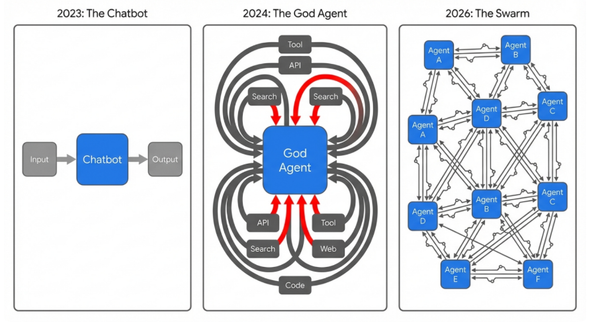
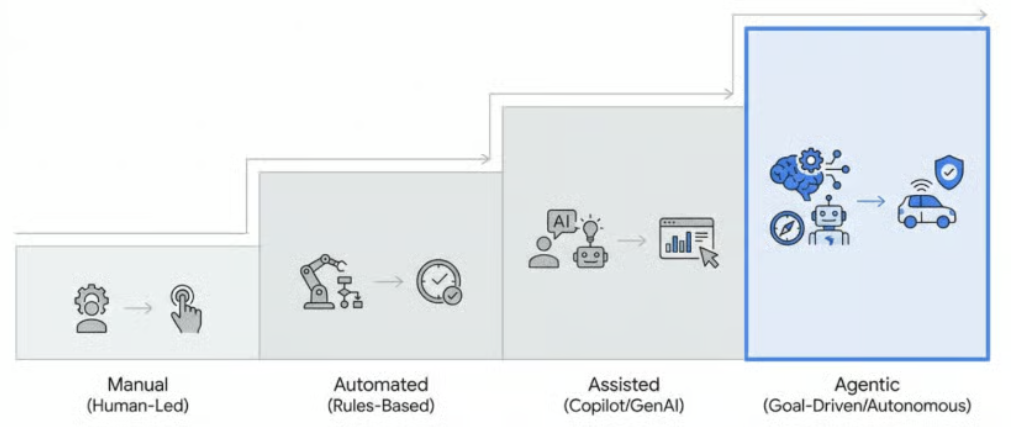
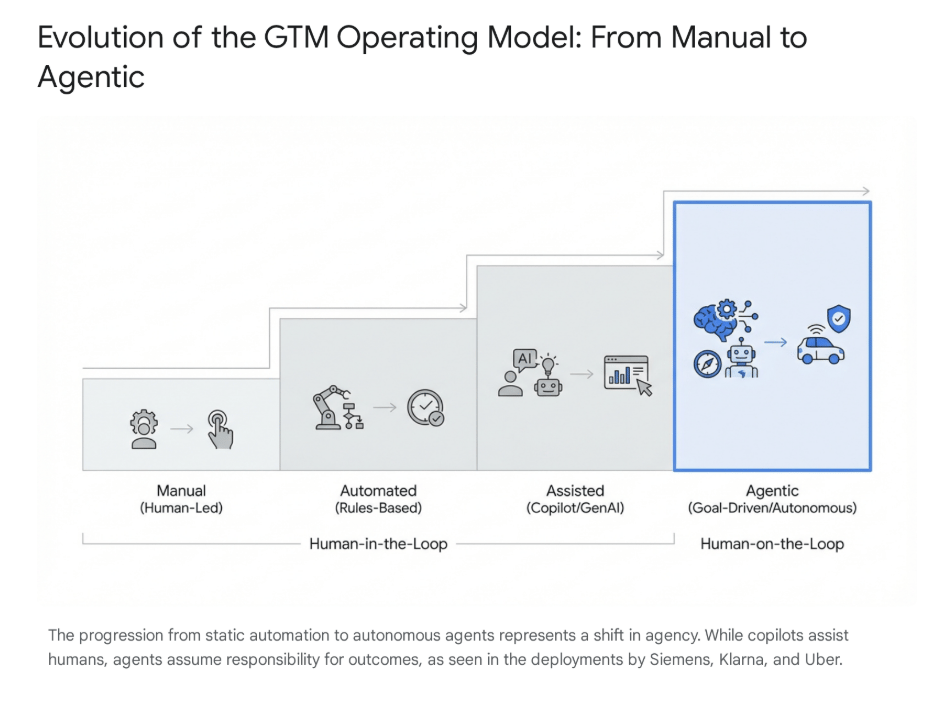
We are witnessing a structural transformation in the market comparable to the shift to cloud computing. We are migrating from Assisted Intelligence (Copilots)—where you constantly nudge the AI to do a discrete task—to Agentic Intelligence, where the system perceives, plans, and executes complex workflows itself.
This isn’t just about efficiency; it’s about a fundamental reimagining of the firm. It’s the difference between technology that supports labor and technology that is labor. In this new model, agents don't just "help" us work; they become active participants in the economy, capable of independent contribution.
Credit: Google Ultra Deep Research
I’ve been analyzing how top-tier firms are actually deploying these agents across their entire Go-To-Market (GTM) funnel. This isn't theoretical—companies like Siemens, Uber, and JPMorgan Chase are already running their core operations on this infrastructure.
Here is the "state of the union" on Agentic GTM, and more importantly, how you can apply it.
1. Strategy: The End of Static Research
Historically, strategic planning was a manual grind of gathering data, synthesizing market signals, and building static "battlecards" that were often obsolete the moment they were published. That era is ending. We are moving to a world of continuous, automated market surveillance.
- JPMorgan Chase is using IndexGPT to automate the complex construction of investment theses. Instead of relying solely on analysts to track trends, agents scan news, filings, and earnings calls to identify emerging themes (like "cloud computing") and the companies driving them. Critically, these agents can distinguish context—differentiating between a company that uses AI and one that produces it—doing the heavy lifting so strategists can focus on portfolio construction and risk management.
- McKinsey & Company deployed "Lilli" to 17,000 consultants. This isn't just a search bar; it's an orchestration layer that synthesizes decades of proprietary research and client data. It has reduced time-to-insight for research tasks by nearly 30%, effectively turning every junior consultant into a super-analyst capable of accessing the firm's collective brain in seconds.
- Vasion (via Crayon) shows us the future of competitive intelligence. They shifted from static battlecards to active "Compete Agents" that monitor competitor pricing, website changes, and regulatory filings in real-time. This turns the strategy function from a reactive "hunting" exercise into a proactive "interpretation" exercise.
The Takeaway: Agents are now the "eyes and ears" of your strategy team. The competitive advantage is no longer access to information, but the judgment to act on it.
2. Marketing: The Content Supply Chain
We used to talk about AI writing blog posts. Now, we’re talking about AI governing global brand operations and managing the entire content supply chain—from creation to compliance.
- Uber uses agents to manage a "unified knowledge ecosystem." Operating in hundreds of markets, Uber faces a nightmare of regulatory nuance. They deployed agents to ensure support content is legally compliant and on-brand across every region. These agents distinguish between "System 1" tasks (repeatable, quick reactions) and "System 2" tasks (complex reasoning), automating the former to free up humans for the latter.
- Qualcomm offers a masterclass in cross-functional agentic workflows. They built a "Brand Voice Agent" to rewrite technical copy into their specific brand tone, but they didn't stop there. They paired it with a "Legal Compliance Agent" trained on over 1,200 trademarks. This dual-agent system ensures that marketing assets are not only creative but legally cleared before a human ever reviews them, saving marketing and legal teams thousands of hours.
- Blue Yonder uses revenue agents to orchestrate Account-Based Marketing. The agents identify anonymous web traffic and dynamically construct personalized dialogues based on the buyer's industry and intent signals. It effectively acts as an autonomous "traffic controller," routing high-value prospects to sales while nurturing lower-value ones automatically.
The Takeaway: This is no longer about generating text; it’s about managing a "content supply chain" that is compliant, localized, and always on.
3. Sales: From Enablement to Autonomy
This is where the deployment is most aggressive. We are moving from "sales enablement"—helping humans sell—to "more sales autonomy," where digital workers handle the prospecting and qualification lifecycle.
- Siemens stands as a canonical example for the enterprise. They faced a volume problem: 2,800 inbound leads per week and limited human capacity. They deployed a multi-agent system via Salesforce that engages every lead within minutes. A "Qualification Agent" vets them against BANT criteria (Budget, Authority, Need, Timeline) and only routes the "sales-ready" opportunities to humans. This ensures their highly paid engineering sales staff focus solely on qualified deals.
- The Rise of the "Digital Worker": Companies like 11x.ai are deploying fully autonomous agents like "Alice" (SDR) and "Jordan" (Voice) that don't just assist—they replace the SDR function for specific segments. These agents research prospects, craft personalized emails, handle objections, and book meetings 24/7, without suffering from rejection fatigue. (Note: I’ll have a LOT more to say on this, not all of it is good.)
- Morgan Stanley demonstrates the augmentation path. Their "AI @ Morgan Stanley Assistant" listens to client meetings, drafts follow-up emails, and suggests the "next best action" (like a tax strategy) based on the conversation. It reduces the "research latency" that kills deal momentum.
The Takeaway: Let agents handle the volume so your humans can handle the value. The future sales team is a hybrid of high-volume digital workers and high-touch human experts.
4. Customer Success: Proactive and Physical
The post-sales world is seeing massive ROI by shifting from reactive "break-fix" models to proactive value realization.
- John Deere connects agents to the physical world. Their systems monitor equipment telemetry (like a tractor’s spray nozzle performance) and proactively alert dealers if a customer is underutilizing the machine. This turns the dealer from a repair shop into a proactive consultant, driving revenue through performance optimization rather than just parts replacement.
- Honeywell is empowering the "deskless worker." They deployed agents on handheld devices that use computer vision and voice to help warehouse and retail workers. A worker can point a device at a machine part and ask, "How do I fix this?" The agent identifies the part and provides the answer, bridging the skills gap and solving problems at the edge.
- Klarna made headlines with an AI assistant that handles two-thirds of all customer service chats—doing the work of 700 full-time agents. However, their journey highlights a critical nuance: they are re-introducing humans for complex, emotionally charged issues. This proves that while agents excel at transaction, humans excel at empathy. The goal is precise orchestration between the two.
The Takeaway: The best service is the one the customer never has to ask for. Agents make that proactive layer possible.
The Bottom Line
The companies winning right now aren't just plugging chatbots into broken processes. They are redesigning their GTM engines to be "agent-first."
The goal isn't to replace your team. It's to liberate them. By handing the "first mile" of information gathering and the "middle mile" of coordination over to agents, you free your people to own the "last mile"—the judgment, the relationship, and the close.
Thanks for reading,
Troy