Claude Just Shipped Self-Service BI And Buried It Under A Nerdy Name
I started my sales career 20 years ago at Business Objects (which had just acquired Crystal Decisions). We sold reporting systems on top of data warehouses with massive metadata management tools and expensive dashboards that were often wrong. The dream was a system you could talk to where it could just find the data, do the transformations and build the dashboards. Claude just shipped a version of that, but people may not get the importance of it because of the nerdy product naming (Claude Live Artifacts).
This post is an attempt to set out what the feature is, how it works, where the edges are in the first 48 hours of public use, and what I think the signal is for anyone making a platform bet this quarter.
What it is
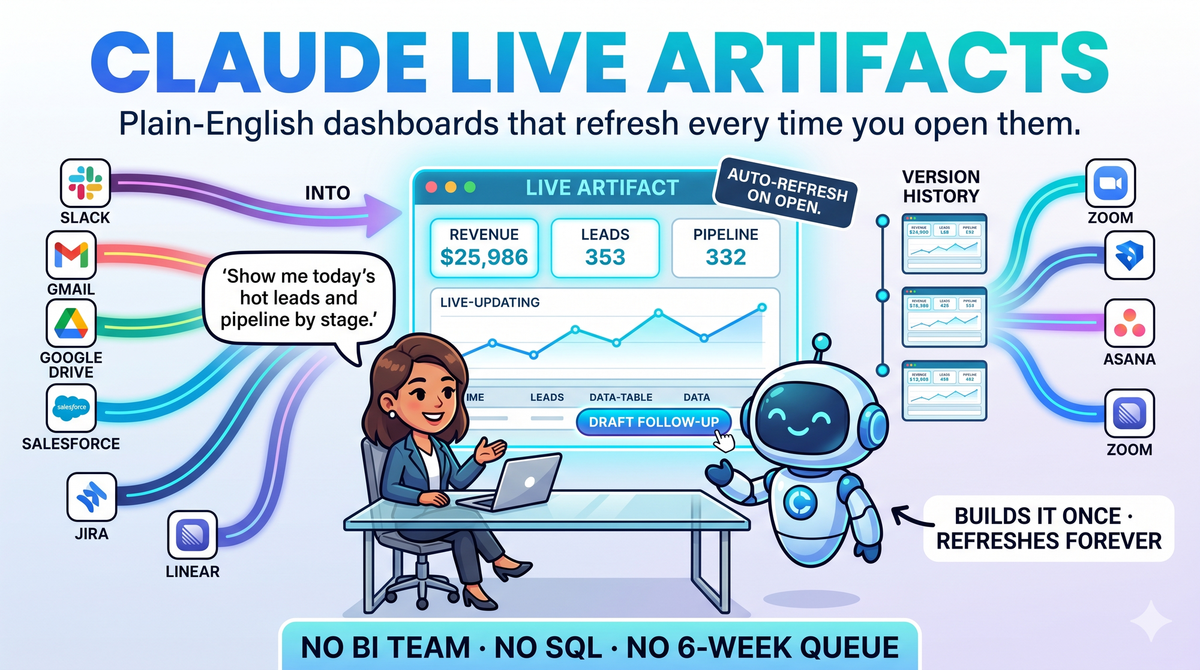
A Live Artifact is a dashboard or tracker that lives inside Claude Cowork and stays connected to the systems it was built from. You describe what you want in plain English. Cowork figures out which connectors to hit and builds you an HTML dashboard in the sidebar. The next morning you open it, Claude re-runs the whole thing against live data, and the view rebuilds. Every refresh makes a new version, so "what did this dashboard show last Tuesday" has a real answer without anyone digging through chat logs.
Live Artifacts reach whatever Cowork already reaches through MCP, which today includes Slack, Gmail, Drive, Salesforce, Jira, Confluence, Asana, Linear, Intercom, Zoom, and a growing list of others. If Cowork can talk to it today, an artifact can refresh from it tomorrow. The feature is Cowork-only right now, meaning it is not available in chat, in the API, or on the free tier, and it runs only on paid plans on Mac and Windows desktop starting at $20 per month for Pro.
How it actually works
The shift that matters is that the report is now the query. In the old BI world the dashboard was an output, produced on a cadence by a BI team or an overnight job. Here the dashboard is a specification Claude re-runs the moment you look at it. You are not refreshing the dashboard. Opening it is the refresh.
The piece most of the early coverage is underselling is that a Live Artifact can include buttons, forms, and logic, not just charts. You can put a "draft follow-up" button next to each lead in a lead tracker and have Claude write the email and update the stage. You can put a "write me a script about this" button next to a trending topic in a content dashboard. The artifact stops being a view of the business and starts being the place you run the business from. That is the piece that changed how I think about this category.
Where the edges are
One of the more careful early testers (Ryan, who takes the time to actually push on the product) built a real e-commerce dashboard on top of a 20,000-row Google Sheet and hit three limits worth naming. The first was data volume: the current implementation handles a few thousand rows cleanly, and past that parts of the view quietly stopped refreshing and became a snapshot of whatever state Claude had at build time. The second was build latency: a full dashboard took him 10 to 15 minutes to stand up, and adding one extra chart took about as long again. The third was general zero-day roughness, which showed up as a number flipping between refreshes, a UI that occasionally dropped the artifacts panel, and some connectors that pulled the wrong field and had to be corrected by hand.
A few more edges are worth surfacing if you are thinking about deploying this at an enterprise. The security posture around shared artifacts is not documented yet, and a shared artifact inherits the OAuth scopes of whoever created it on every refresh, which is a permission surface I would not put on top of regulated data until Anthropic ships the doc. The connector footprint sets the ceiling, so if you have a legacy system with no MCP route, no Zapier bridge, and no clean export, the dashboard is going to be quietly blind to it. And Cowork-only means browser-only or locked-down deployments are a non-starter until that changes.
The signal
For a couple thousand rows of operational data, and a business owner who knows what they want to see and can describe it plainly, this thing works. That is the first time I have been able to say that about any self-service BI tool I have touched. It is not replacing a governed million-row Snowflake warehouse, it is not trying to, and Anthropic has been honest about that.
What it is is a reporting surface that lives where the operator lives, reads from the systems the operator already uses, and does the last-mile translation from structured data into a view the human can act on, with no BI team in between. That is a different category from anything SAP, IBM, or Oracle shipped in the legacy BI era, and it is a different category from anything ChatGPT, Gemini, or Notion AI is shipping right now.
Live Artifacts is Cowork growing up. The operator is the person whose work used to be gated by a BI queue, and that queue is finally shrinking.
It is also one of 36 major features Anthropic has shipped across Claude, Cowork, and Claude Code since January 1, averaging one every three days for 16 straight weeks. I have been keeping the list and I have never seen a company in any category ship at that cadence. Each release on its own is a feature, but the pace is the story. For anyone making a platform bet this quarter, the question is not whether Live Artifacts will be useful on Friday, because it will be. The question is what the Cowork surface will look like 16 weeks from now if the cadence holds.