Native Integration Capabilities in Modern Outbound Stacks
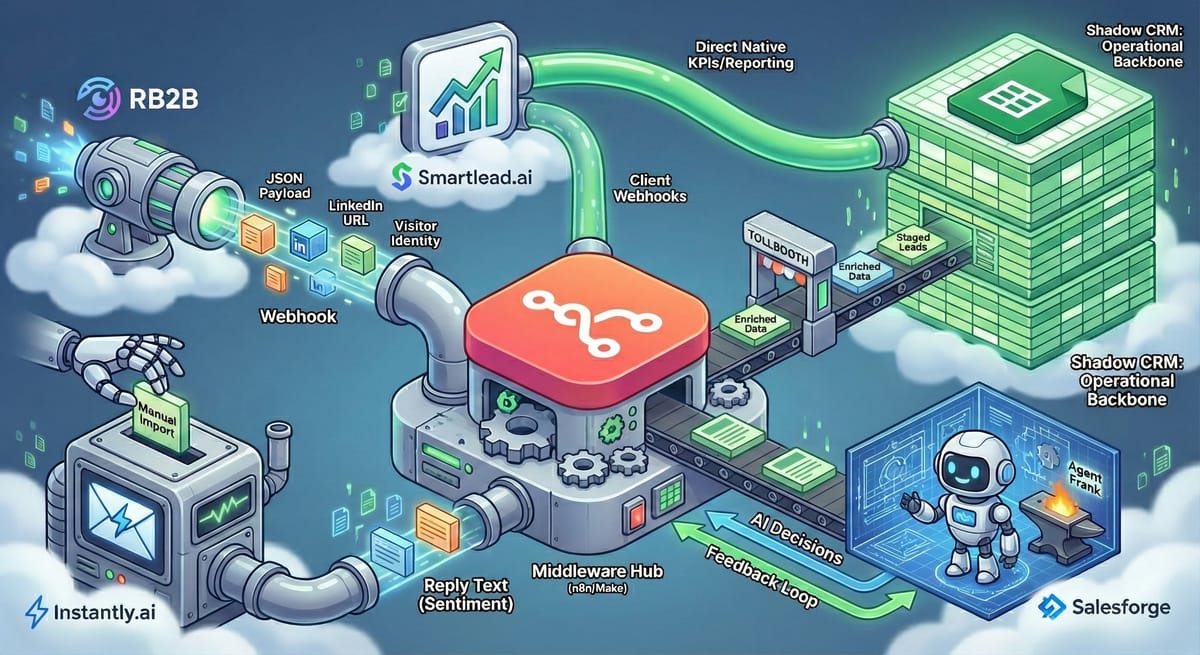
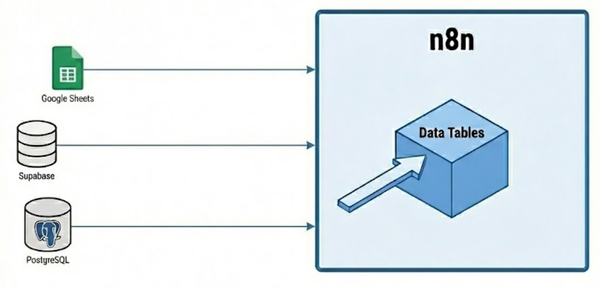
In high-velocity revenue operations, the CRM (Salesforce/HubSpot) is the system of record, but Google Sheets is the operational backbone. This "Shadow CRM" architecture persists because of its inherent flexibility compared to rigid CRM schemas. It serves as a distinct architectural layer between data acquisition and execution, handling a cyclical workflow: Ingestion (raw leads from scrapers), Enrichment (cleaning via Clay/VAs), Staging (segmentation), and Feedback (logging engagement to prevent re-prospecting).
We conducted a technical analysis of four leading apps—RB2B, Instantly.ai, Smartlead.ai, and Salesforge—to determine which possesses the best native integration with Google Sheets.
The short answer: "Native" integration is largely a myth. The industry has shifted significantly toward middleware-assisted architectures (Zapier/Make), creating a distinction between "True Native" server-to-server connections and "Middleware-Assisted" workflows.
Here is the deep-dive technical breakdown of the current landscape:
1. RB2B: The Visitor Intelligence Source
RB2B occupies a unique position as a data origination platform (identifying anonymous visitors) rather than a sender.
- The "Native" Gap: There is no built-in "Push to Sheets" button. The platform prioritizes direct integrations with HubSpot and Salesforce. For Google Sheets, it relies entirely on a generic Webhook mechanism.
- Payload Richness: Despite the lack of UI convenience, the data payload sent via webhook is exceptionally rich and immediately actionable. It includes "Person-Level" identity data (LinkedIn URL, Name, Job Title) and contextual metadata (Captured URL, Referrer, "Seen At" timestamp).
- Operational Reality: To use RB2B with Google Sheets, you must build the infrastructure yourself. You are responsible for configuring a listener (Zapier/Make) to parse the JSON and map fields to columns. While powerful, it is uni-directional; updating existing rows for repeat visitors requires complex "Search & Update" logic in your middleware, which is often prone to errors.
2. Instantly.ai: The Volume Execution
Instantly is widely recognized for its "Unibox" and sending volume, but its relationship with Google Sheets is characterized by manual ingestion rather than continuous sync.
- Input Limitations (The "Pull" vs. "Sync" Distinction): Instantly advertises an "Import from Google Sheets" feature, but technical scrutiny reveals this is a manual fetch capability. It reads data at a single point in time. There is no background listener that automatically pulls new rows; true automation requires a "New Row" trigger in Zapier.
- Output & Sentiment Analysis: Instantly lacks a native "Log to Sheet" toggle. However, its middleware support allows for sophisticated workflows. The "Lead Interested" trigger in Zapier includes the full reply_text in the payload. This is a high-value feature for GTM engineers, as it allows you to pipe replies into a Sheet where a secondary script (or AI) can perform sentiment analysis, logging not just that a reply happened, but what was said.
- Workspace Integration: While the Sheets integration is middleware-dependent, Instantly offers deep, native OAuth integration for Google Workspace email accounts, simplifying the connection of sending inboxes without manual App Passwords.
3. Smartlead.ai: The Reporting Engine
Smartlead positions itself as the infrastructure choice for agencies, offering a "developer-centric" approach that surprisingly yields the best native reporting capabilities.
- Native-Like Reporting: Smartlead stands out with a capability to pipe campaign performance statistics (KPIs) directly into Google Sheets automatically. This solves a massive operational headache for agencies: providing client transparency without granting platform access. This functions as a "Write" operation from the platform to the Sheet without a middleware tax.
- Webhook Hierarchy (Client vs. Campaign): Smartlead demonstrates superior architecture for scale. It allows for Client-Level Webhooks, aggregating events for all campaigns under a single client into one stream. This is significantly more efficient than setting up 50 separate webhooks for 50 campaigns, allowing for a single "Master Sheet" to capture all activity.
- Cost Control: The ability to filter webhooks by event type (e.g., only fire on "Reply," ignore "Open") is a critical feature for controlling middleware costs, preventing thousands of low-value "Open" events from eating up Zapier task limits.
4. Salesforge: The Workflow Architect
The Salesforge ecosystem (including Mailforge/Infraforge) is the newest entrant and treats middleware as a first-class citizen rather than a workaround.
- Template-First Architecture: Salesforge does not pretend to have a simple native plugin. Instead, they provide ready-to-use templates for Make and n8n. This acknowledges that modern RevOps teams need complex logic (e.g., "Check if email exists in CRM before importing") that simple buttons cannot support.
- Agent Frank & The Feedback Loop: The platform's unique value is "Agent Frank," an autonomous AI SDR. The integration requirement here is bi-directional: Sheets feed the agent, and the agent must log its autonomous decisions back to the Sheet. The provided templates facilitate this audit trail, ensuring human-in-the-loop oversight.
- State-Change Triggers: Salesforge offers a "Watch Label Changed" trigger. This allows Google Sheets to act as a real-time monitor of deal flow (e.g., triggering an update when a lead is marked "Meeting Booked") rather than just monitoring raw volume.
The Hidden Cost: The "Middleware Tax"
Reliance on Zapier, Make, or n8n across these platforms introduces a hidden "Middleware Tax" that technical leads must account for:
- Latency: workflows are rarely instant on standard plans.
- Fragility: If a column name in your "Shadow CRM" changes, the integration breaks.
- Cost: High-volume senders generate thousands of events daily. Pushing every "Open" event to Sheets via middleware could incur high monthly costs.
Summary Recommendation
Stop looking for a "Connect" button and start evaluating API richness and architectural fit.
- For Reporting & Visibility: Use Smartlead. Its native piping of campaign data and client-level webhooks offer the best visibility for agencies while minimizing middleware costs.
- For AI & Complex Logic: Use Salesforge. Their template-first approach using n8n/Make offers the highest ceiling for automation, essential for managing autonomous agents.
- For Visitor Data: Use RB2B, but understand you are building a data hose. The payload richness (LinkedIn URLs) justifies the effort of engineering your own capture pipeline.
- For Manual Simplicity: Use Instantly if your workflow is primarily manual batch uploads and you do not require real-time bi-directional syncing.
Thanks for reading.
Troy