The end of predictable revenue and the birth of hybrid human+AI sales teams
If you’ve been feeling like the old playbook for generating B2B revenue isn't working like it used to, you aren’t crazy. You’re just paying attention.
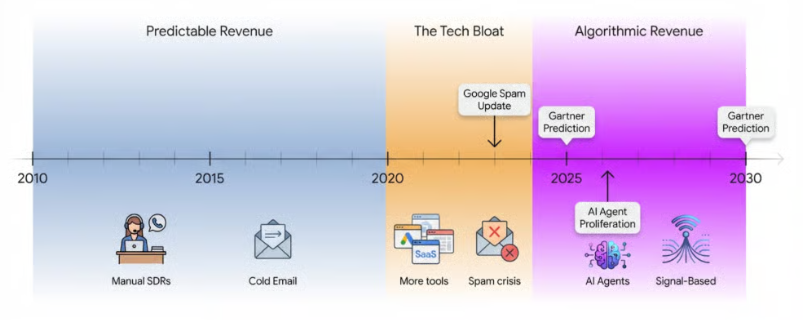
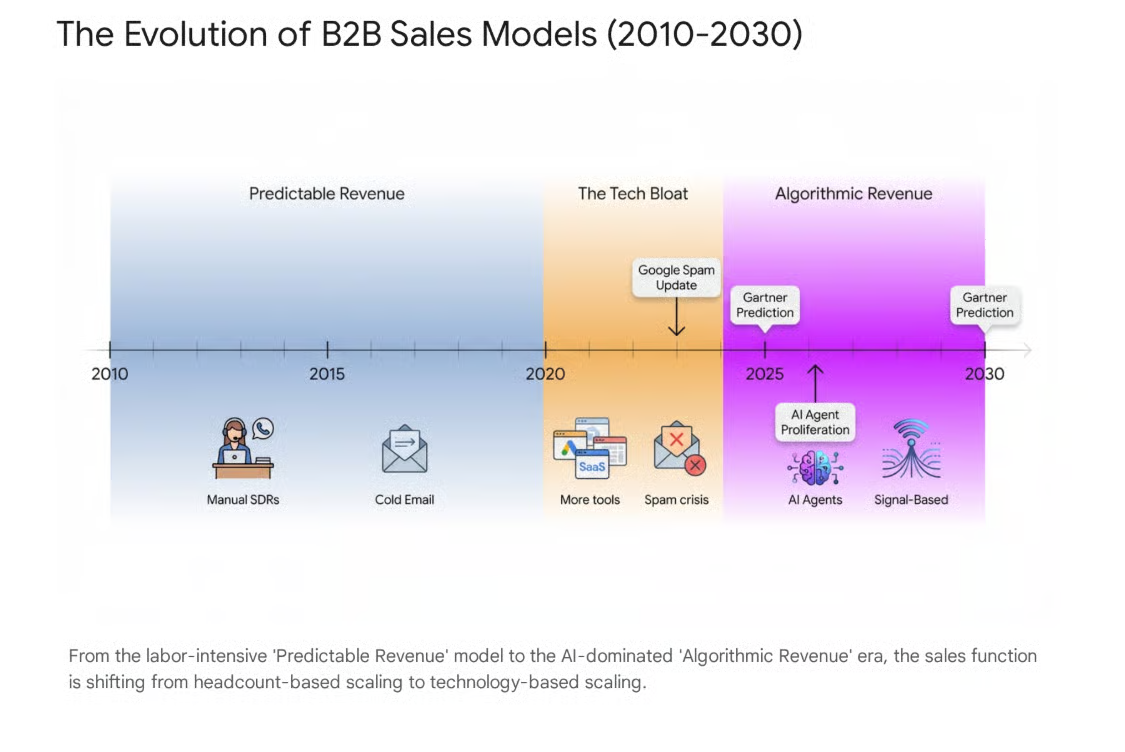
For the last 15 years, we’ve all been operating on the "Predictable Revenue" model. You know the drill: hire a battalion of SDRs, arm them with scripts, point them at a list of cold leads, and wait for the meetings to roll in. It was the assembly line applied to intellectual labor—a linear equation where More Activity = More Revenue.
But looking at the hard market data from 2024 and 2025, I have to be the bearer of bad news: The assembly line has stalled.
Here at Productive AI, we’ve been rigorously auditing the "why" behind this collapse. What we found is that this isn't a temporary dip; it's a phase transition. I want to share exactly what we’re seeing—not to alarm you, but to arm you with the data you need to pivot before your competitors do.
Why the Old Math Stopped Working
It’s not a failure of effort; it’s a structural obsolescence. The physics of the market have changed in three fundamental ways.
1. The Economics Don't Pencil Out (The "Burn Multiple" Problem) In the Zero Interest Rate Policy (ZIRP) era, capital was cheap, and we could afford inefficient growth. Investors often looked the other way on high customer acquisition costs (CAC) as long as top-line revenue was growing.
Today, the CFO's office has taken the wheel. The focus has shifted entirely to the Burn Multiple—how much cash you burn to generate each net new dollar of ARR.
- The Old Reality: You could spend $2 to make $1.
- The New Reality: Best-in-class companies are aiming for a Burn Multiple of <1.0x.
Under the traditional model, this math is brutal. The cost of a fully loaded SDR (salary, commissions, tech stack, benefits) often exceeds $120,000 to $150,000 annually. Meanwhile, quota attainment has stagnated industry-wide at around 53%. When you factor in the ramp time and the management overhead, CAC payback periods have drifted to 18–24 months for many SaaS companies. In a high-interest-rate environment, acting as a bank for your customers for two years is simply not sustainable.
2. The Gatekeepers Closed the Gates For years, the response to low conversion rates was "brute force"—just send more emails. If conversion drops, double the volume.
That tactic is now dead. In 2024, Google and Yahoo implemented the strictest email sender requirements in the history of the open web. They enforce a hard spam complaint threshold of 0.3%. That means just 3 complaints per 1,000 emails can get your entire domain blacklisted. The "spam cannon" approach isn't just inefficient anymore; it is an existential risk to your company's digital reputation.
3. Buyers Changed (Radically) Perhaps the most critical shift is psychological. Gartner data shows that 75% of B2B buyers now prefer a rep-free experience.
Buyers have migrated to the "Dark Funnel"—private Slack communities, podcasts, and peer review sites where vendors can’t track them. They are self-educating. By the time they "raise their hand" for a demo, they are often 70% of the way through their buying journey. Placing a junior SDR as a "gatekeeper" to qualify this high-intent buyer creates friction exactly when you need velocity. They don’t want to be BANT-qualified; they want expert consultation.
Welcome to the "Algorithmic Revenue" Era
We are moving from a model defined by headcount to one defined by computing power. We call this the Algorithmic Revenue Engine.
It’s not just about replacing humans with robots; it’s about a smarter architecture built on three pillars:
- The Hands (Agentic AI): We need to stop thinking about "automation" (tools that help you work) and start thinking about "agency" (tools that do the work). We are seeing the rise of autonomous AI agents (like 11x.ai or Artisan) that act as "digital workers." Unlike human SDRs, these agents can self-source prospects, navigate complex data sets to find the right contacts, and hyper-personalize outreach at infinite scale. They operate 24/7, they don't suffer from rejection fatigue, and they continuously learn from reply data to optimize their own messaging.
- The Eyes (Signal-Based Selling): The days of the static "Target Account List" are over. Relying on firmographics (e.g., "Companies with 500+ employees") results in timing mismatches. The new winners are using "Signal Feeds"—dynamic triggers that answer the question: "Why reach out now?"
- Champion Movement: A past user joins a target account (the highest converting signal).
- Tech Installs: A prospect installs a competitor or a complementary tool.
- Hiring Spikes: A sudden search for "Head of Security" indicates budget and intent. This shifts the workflow from "spraying the list" to "sniping the signal."
- The Trust (Nearbound): In a world flooded with AI-generated noise, trust is the scarcest asset. Cold outreach is seeing diminishing returns because nobody trusts an unsolicited email. "Nearbound" strategies leverage your ecosystem—partners, investors, advisors—to get warm intros. Instead of selling to a company, you sell with the people that company already trusts. Cold paths are dying; warm paths are the future.
What Should You Do Today?
This transition can feel overwhelming, but the path forward is actually about simplification and upgrading your "Revenue Architecture."
1. Stop solving efficiency problems with more bodies. Before you open another SDR requisition, pause. Ask if that role is truly adding value or just adding friction to the buyer's journey. Could an AI agent handle the top-of-funnel prospecting for 1/10th of the cost? This allows you to reinvest those savings into higher-quality, full-cycle human talent.
2. Audit your "Spam Cannon." Look at your current incentives. If your team is incentivized on activity metrics (dials/emails per day) rather than outcome metrics (qualified meetings/revenue), you are fighting the last war. Shift your focus to signal quality. Who is actually raising their hand?
3. Empower your "Cyborgs." The goal isn't to replace your sales team; it's to elevate them. The future belongs to the "Full-Cycle Account Executive"—a seller backed by a fleet of AI agents that handle the administrative grunt work (research, list building, initial outreach). This frees your humans to do what they do best: build relationships, navigate complex deal politics, and close.
We are entering a fascinating time where the barriers to scale are falling, but the bar for quality is rising. The winners will be the ones who can blend the efficiency of algorithms with the empathy of humans.
If you’re looking to navigate this shift—specifically around deploying Agentic operations without breaking your existing flows—hit reply. I’d love to hear how your team is adapting.