The shift from automation to agentic GTM is real
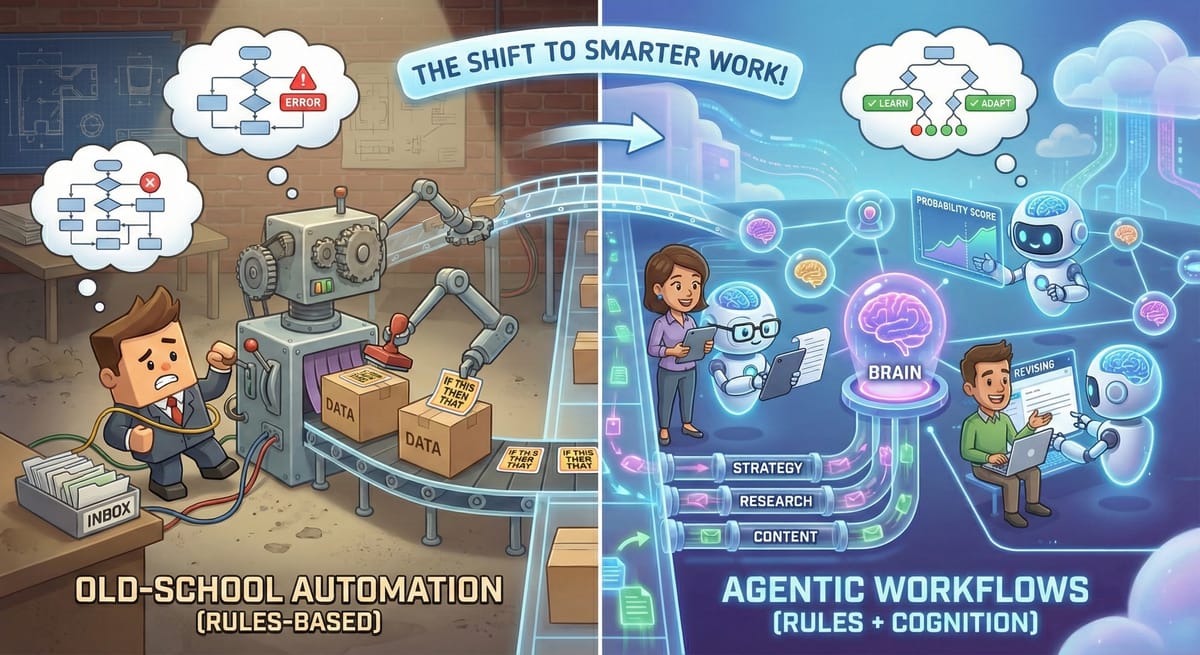
The last six months have marked a definitive transition from the era of "Linear Rules-based Automation" to the age of "Agentic Systems," and I wanted to share what we’re observing in the field.
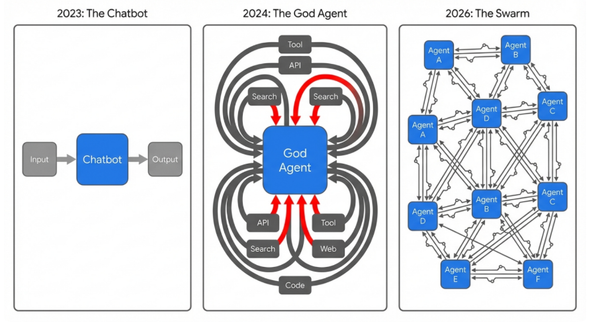
For the better part of a decade, "automation" mostly meant digital plumbing. We relied on rigid, deterministic workflows—typified by the "If This, Then That" logic of platforms like Zapier & Make. These systems were efficient data pipes, capable of moving a form submission to a Slack channel or a row in a spreadsheet. However, they lacked cognition. They could not reason, they could not adapt to unstructured inputs, and they certainly could not correct their own errors. If the data didn't look exactly right, the script crashed.
In late 2025, that linear model has become obsolete.
We are entering the age of Agentic Systems. Instead of just moving data from point A to point B, we can now build workflows that reason, make decisions, and—crucially—correct their own work. We are moving from tools that require perfect inputs to "Fuzzy Systems" that can handle probability, ambiguity, and complex decision-making trees. These aren't just scripts; they are digital labor.
Here is a detailed look at how this is reshaping our Go-To-Market functions.
1. From Linear to Circular (The "Self-Annealing" Workflow)
The most critical technical change we’re seeing is that traditional automation moves in a straight line, while agents work in loops. This concept is often called "cyclic" or looping.
In a traditional setup, if an automation tries to draft an email and it sounds robotic, generic, or hallucinates a fact, it sends it anyway. There is no quality control mechanism. An agentic workflow, however, is designed to mimic the human creative process: drafting, reviewing, and revising.
- The "Critic" Loop: The workflow generates a draft, but instead of sending it, it passes that draft to a second "Critic" agent. This Critic is prompted with our specific brand guidelines and is asked to "redline" the copy.
- Recursive Improvement: If the draft falls short—perhaps the tone is too aggressive or the value proposition is unclear—the workflow loops back. The "Writer" agent takes the feedback from the "Critic" and rewrites the content.
It acts less like a software script and more like a junior employee checking their work before submitting it to a manager. This recursive process is the only way to safely deploy AI in high-stakes client communications without risking brand reputation.
2. Strategy Agents: Automating the "Why"
Until recently, we only automated execution (sending the email, posting the tweet). Now, we are seeing teams automate the strategic thinking that precedes execution.
We are seeing teams deploy "Strategy Agents" that act as digital consultants. They don't just execute a campaign; they determine who to target and what to say based on first principles.
- Gap Analysis & Market Definition: These agents can scan a competitor’s website, digest their pricing pages and case studies, and perform a "Gap Analysis." They identify the specific market segments or "white space" that the competitor is ignoring. They then map our Ideal Customer Profile (ICP) against that gap to create a target list that is strategically aligned, not just a random download.
- The "Problem-Solution" Matrix: Beyond just static lists, agents are now monitoring industry news via RSS feeds. When a significant event occurs (e.g., a new compliance regulation), the agent triggers a workflow to generate a "Problem-Solution" matrix. It identifies the new problem, maps it to our solution, and generates a hook (e.g., "Are you ready for the new SEC deadline?"), ensuring our strategy is reactive to real-time market conditions.
3. Top of Funnel sourcing
Finding people who have the problem is the next step. We are seeing a shift from passive social listening dashboards to active "Hunter" agents that monitor platforms like LinkedIn, Reddit, and Twitter/X for high-intent signals.
- Signal Detection: Tools like Octolens or PhantomBuster monitor for "Problem-Aware" phrases (e.g., "Zapier alternative," "compliance help").
- The Gatekeeper Node: Raw mentions are often noise. To prevent spamming, successful workflows pass the text of the mention through an LLM "Gatekeeper." We prompt this agent to rate the post from 0-10 on buying intent.
- The Outcome: If the score is low (complaints about pricing), it ignores it. If the score is high (technical pain points), it triggers a "Soft Engagement"—drafting a helpful comment to position the brand as an expert—or adds the user to a cold outreach list.
4. Content Orchestration: Depth Over Speed
For marketing leaders, the shift in content creation is moving from "one-shot" generation to "recursive" orchestration. The days of asking ChatGPT to "write a blog post" and publishing the flat, repetitive result are over.
- Recursive Long-Form Agents: Advanced workflows now use a "Chain of Density" approach. The agent breaks a topic into an outline, then writes section by section. Crucially, it passes the context of previous sections into the next prompt, ensuring the narrative flows logically and doesn't suffer from "context drift."
- The Viral Engine: For social channels, agents are using Retrieval-Augmented Generation (RAG) to access a "Voice Database" of a specific executive's past successful posts. This allows the model to mimic specific stylistic quirks—short sentences, contrarian questions—ensuring that high-volume output doesn't sound like a generic bot.
5. The End of "Spray and Pray" Outbound
In outbound sales, the volume game is effectively over. With email providers cracking down on spam, the only way through is extreme relevance. The new standard is "Waterfall Enrichment" and deep research.
- Waterfall Data Accuracy: Buying pre-made lists is expensive and often results in stale data. Modern workflows "waterfall" through multiple providers to optimize cost. The agent checks a low-cost API (like Apollo) first. If it can't find a verified email, it escalates to a premium verifier (like Prospeo or Findymail). This ensures you only pay premium prices for hard-to-find leads.
- The "Dossier" Approach: Agents are now building "Research Dossiers" on every prospect before a message is drafted. They read the prospect's recent LinkedIn activity and their company's latest blog posts to find a specific "trigger event."
- Constraint-Based Drafting: The drafting agents are explicitly forbidden from using generic openers like "I hope this finds you well." Instead, they are prompted to use "interest-based" Calls to Action (e.g., "Worth a chat?") rather than "time-based" ones (e.g., "Are you free Tuesday at 2pm?"), which data shows have higher conversion rates.
6. Speed and Quality in Inbound
For revenue leaders, the two metrics moving the needle right now are Speed to Lead and Qualitative Scoring.
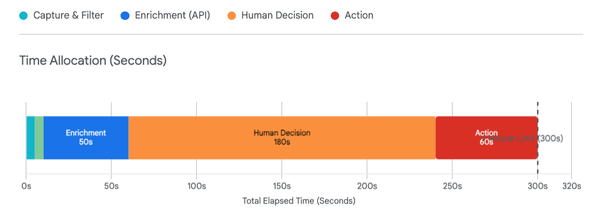
- Speed (The "Whisper" Workflow): We are seeing workflows that trigger a phone call to a sales rep the second a lead comes in. Using text-to-speech, the agent "whispers" a summary of the prospect (name, company size, intent) to the rep before bridging the call to the lead. This reduces response time from hours to minutes, catching the prospect while they are still psychologically engaged with your site.
- Quality (The AI Judge): Instead of scoring leads based on arbitrary arithmetic (+5 points for a click), agents are reading form submissions and judging them like a human would. The agent compares the enriched data against your ICP and assigns a 0-100 score with a written justification. Is the budget realistic? Does the use case match our product capabilities? This ensures your high-value Account Executives only speak to high-value prospects, while lower-tier leads are routed to automated nurture sequences or politely disqualified.
7. Event & Success Automation
Even areas like Webinar management and Contract generation are being transformed from manual checklists into self-driving processes.
- Contextual Reminders: Standard webinar reminders are generic ("Starting in 1 hour"). Agentic workflows now review the registrant list 24 hours prior and use the attendee's Job Title to customize the "Why you should attend" bullet point. A CTO gets a bullet about architecture; a CFO gets one about ROI.
8. The Strategic Infrastructure Decision
Finally, a note on the "Operating System" for these agents. We are seeing a divergence in platform choice that belongs on the CEO's radar.
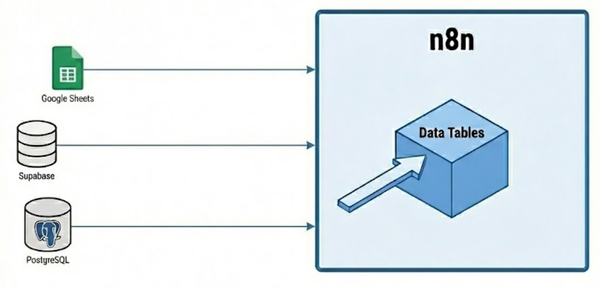
- The "Power User" Path (n8n): For complex, high-performance agents (especially those requiring deep scraping or custom code), platforms like n8n are becoming the standard. They offer self-hosting options, which is critical for data privacy.
- The "Enterprise" Path: For internal productivity (e.g., meeting prep agents, email summarizers), customers are also leveraging Google or Microsoft's extensive agentic toolkit or even the LangChain ecosystem. While more costly to build on than n8n, their security and native integration make it a strong contender for internal tooling.
Where to Start?
If you are looking for "low hanging fruit," we generally recommend starting with Inbound Triage. It offers immediate time savings for your sales team and is lower risk than unleashing an automated outbound bot. It allows you to test the "reasoning" capabilities of these models internally—training them to score leads correctly—before putting them in front of your reps.
It is worth exploring how these architectures can fit into your 2026 roadmap. The technology is no longer theoretical; it is built, templated, and ready to deploy. If you want to discuss specific architectural maps of what is working right now, let's schedule a time to walk through the details.
Troy