The three platform battle for your agentic future has begun
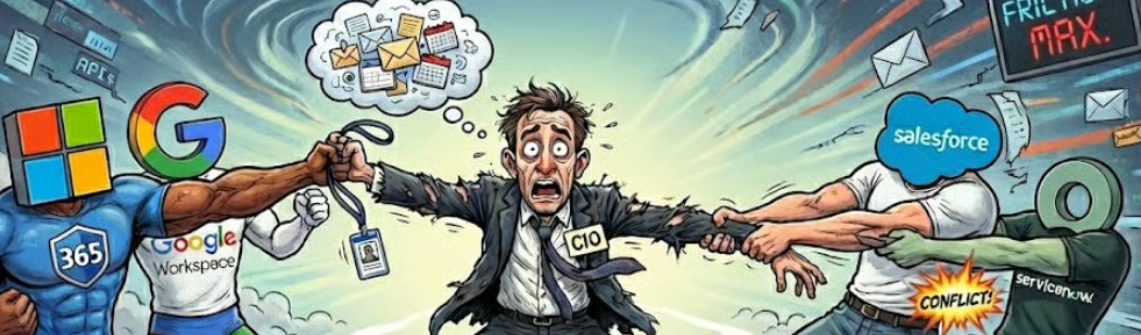
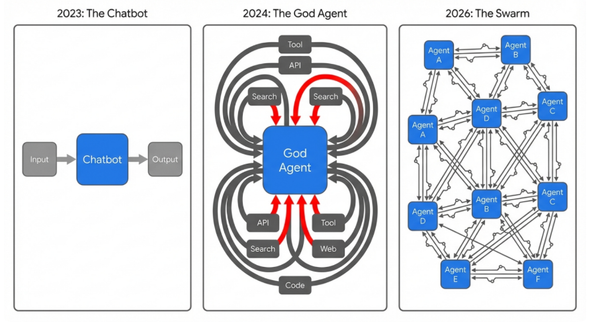
The Era of the Chatbot is over. The Era of the Agent has begun. And it’s going to be an all-out brawl.
We have moved decisively past the "Generative AI" phase—which was mostly about summarizing text, generating marketing copy, and simple chat interfaces—into the "Agentic AI" phase.
The distinction is critical, and it’s one that every executive needs to internalize immediately. We are no longer building software that chats or predicts the next word in a sentence; we are building software that works. These are autonomous entities capable of reasoning, planning, and executing multi-step workflows to achieve complex business objectives without you holding their hand.
The strategic battlefield for 2026 isn't about model performance; it is about the control plane—the orchestration layers, protocols, and governance structures that determine how these digital employees behave when no one is watching.
The "Three-Platform Problem"
You (or your CIO) is likely staring down three disconnected ecosystems fighting for dominance. I call this the "Three-Platform Problem," and it is the primary source of operational friction in the enterprise today. You aren't just choosing software anymore; you are choosing where the "brain" of your company will live for the next 10-20 years.
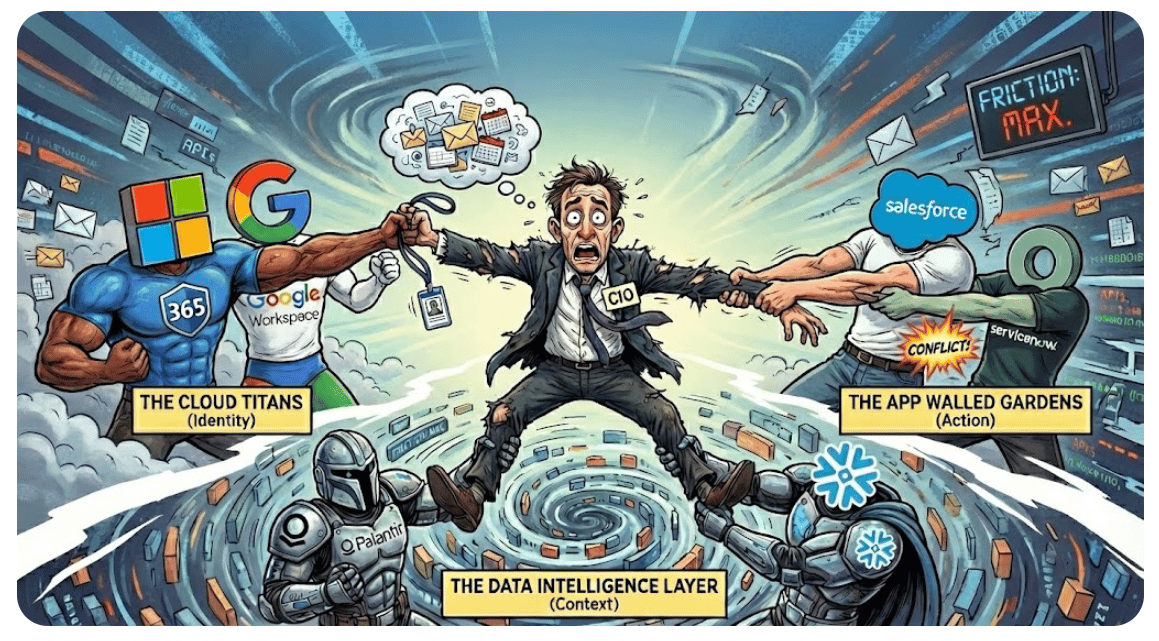
1. The Cloud Titans (Microsoft & Google): The War for Identity
They want to own the identity of work—the layer where authentication happens.
- Microsoft is pushing "Agent 365" to be the operating system of your business. They are banking on the fact that they already own your email, your calendar, and your documents.
- Google has upended the board with Google Workspace Studio. As of December, they effectively democratized agent creation. Now, any employee can spin up a "citizen agent" in Drive to automate workflows. This creates massive innovation but introduces terrifying "Shadow AI" risks. Imagine a finance analyst creating a bot to auto-email quarterly projections without any IT oversight.
- The Fix: Google’s new Gemini Enterprise Service Principals are critical here. You can now assign a non-human identity (think of it as a "blue badge for bots") to these agents. This ensures you know exactly who deleted that spreadsheet—a human or a Workspace Agent—and allows you to revoke that agent's badge without firing the human who built it.
2. The App Walled Gardens (Salesforce & ServiceNow): The War for Action
They are fighting to be your "System of Action." They don't want to just hold your customer data anymore; they want their agents to actively manage it.
- The Conflict: This is a civil war. Salesforce wants Agentforce to handle IT tickets ("I need a laptop"); ServiceNow’s Now Assist wants to handle customer service cases ("My order is late"). Both are encroaching on the other's territory.
- The Risk: We are seeing "workflow collisions" where a ServiceNow agent "hijacks" a chat session intended for a Salesforce agent. The user is left in a fragmented mess, receiving conflicting notifications from two different bots trying to solve the same problem. ServiceNow’s aggressive expansion into the front office means they are no longer just an IT tool—they are a direct competitor for the "brain" of your business.
3. The Data Intelligence Layer (Palantir & Snowflake): The War for Context
They argue that agents should live where the data lives to minimize latency and hallucinations.
- The Reality: While others build chatbots that write poems, Palantir is building "high-stakes" agents that manage supply chain disruptions and battlefield logistics. Their partnership with Snowflake (cemented in late 2025) admits a new truth: smart agents need governed, zero-latency data access. You cannot build a reliable agent if it has to fetch data across a slow API; the compute must move to the data.
The New Vocabulary: MCP and A2A
If you take one thing away from this email, let it be these two acronyms. In 2026, these protocols matter more than which LLM you use. They are the plumbing that makes the house livable.
MCP (Model Context Protocol): The "USB-C of AI"
- The Problem: Previously, connecting an agent to a Google Drive, a SQL database, or a Slack channel required a custom connector for every single platform. It was brittle and expensive to maintain.
- The Solution: MCP standardizes how agents connect to data. You build an MCP "connector" once, and your internal customer database becomes instantly accessible to Claude, OpenAI, or Agentforce equally.
- The Impact: It democratizes your data layer. You are no longer locked into a vendor because "that's where the integration is." Your data becomes a utility that any approved agent can plug into.
A2A (Agent-to-Agent): The "Org Chart of AI"
- The Update: With Microsoft officially joining Google on this standard in May 2025, A2A is now the law of the land.
- The Function: It allows autonomous agents to discover and negotiate with each other.
- The Scenario: A Sales Agent (living in Salesforce) needs a demo environment for a client. Instead of pinging a human, it uses A2A to find the IT Agent (living in ServiceNow). They negotiate ("I need a standard environment," "Okay, do you have a cost center code?"), and the IT Agent executes the work. This happens horizontally, machine-to-machine, without a human intermediary slowing it down.
Your Strategic Playbook: The Composable Enterprise
The "all-in" strategy is a fallacy. No single vendor—not Microsoft, not Salesforce—can provide a best-in-class stack for your entire enterprise. The winning strategy for 2026 is Composability. You need to match the stack to the workload.
1. Commodity Processes (IT Tickets, HR Requests)
- Stack: SaaS Agents (ServiceNow/Salesforce).
- Strategy: Speed to value. Don't reinvent the wheel. These processes are standard across every company.
- The Trap: Vendor lock-in. You must mandate A2A support in your contracts. If a vendor refuses to let their agent talk to others via open standards, they are building a legacy silo that will trap your data.
2. Complex Decisions (Supply Chain, Fraud, Logistics)
- Stack: Data Agents (Palantir/Snowflake).
- Strategy: Context is King. These agents need "ontology"—a perfect digital twin of your business—to reason correctly. A chatbot cannot understand the ripple effects of a shipping delay on Q3 revenue; a Palantir agent grounded in your ERP system can.
- The Trap: Latency. Do not try to run these complex reasoners over shaky APIs. Run the agent directly on the data platform.
3. "Secret Sauce" (IP, R&D, Proprietary Coding)
- Stack: The Sovereign Stack (LangChain/LibreChat).
- Strategy: Total Control. Run this on your own infrastructure (or private cloud). Never let your core IP leave your perimeter.
- The Trap: Convenience. It is tempting to put your R&D into a public model for ease of use, but you are effectively outsourcing your competitive advantage.
Future-Proofing: The "Switchboard" Architecture
To make this complex ecosystem work, you need a Switchboard. Do not allow your SaaS agents to communicate in a chaotic mesh where everyone talks to everyone. Implement a central "Router Agent"—potentially built on your Sovereign stack—that acts as the traffic controller for your enterprise.
This router performs three critical functions:
- Policy Enforcement: It ensures "Sales Agents cannot access HR files" and "Junior bots cannot authorize payments over $5k."
- Audit Logging: It logs every single A2A conversation, so you have a "black box" recorder when things go wrong.
- Identity Governance: It ensures that when a Google Workspace Agent asks for data, it is doing so via a governed Service Principal identity, not an anonymous request.
The Bottom Line
The organizations that win in 2026 won't be the ones with the flashiest demos or the most expensive pilot programs. They will be the ones that prioritize governance over novelty and orchestration over isolation.
We are building the enterprise nervous system. It’s messy, it’s hard, and it requires new governance muscles.
Thanks for reading.
Troy