Your LLM vendor should not be your landlord
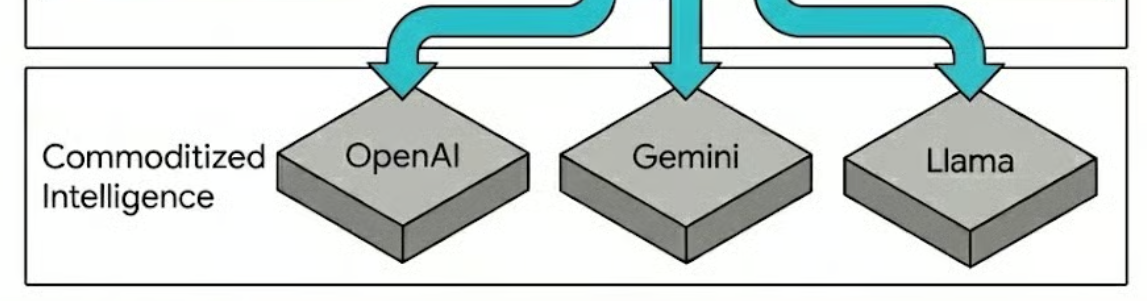
We are entering the era of the Vendor-Neutral AI Stack.
If 2023 was about access, 2026 is going to be about independence. The most forward-thinking organizations are realizing that tight-coupling their corporate memory and business logic to a single model provider (the "walled garden" approach) is a massive strategic risk. Pricing changes, deprecations, and data privacy concerns have made one thing clear: You need to own the architecture, even if you rent the intelligence.
I’ve been analyzing the ecosystem of tools and partners making this shift possible. Here is the executive breakdown of what this "Model-Agnostic Stack" looks like and who is building it.
The Core Philosophy: Decouple Everything
The winning architecture today separates your application layer (your logic, data, and users) from the model layer (GPT-5, Claude, Gemini, Llama).
This decoupling allows you to swap models like commodities. If one vendor jacks up prices or changes terms, you switch the engine without rebuilding the car. While you might still rely on a platform partner, you ensure that your core intelligence isn't locked into a single LLM's roadmap.
There are currently two distinct ways organizations are executing this, and a specific set of consulting partners has risen to meet each demand.
Strategy 1: The "Buy" Approach (Speed & Scale)
The Profile: You are a Global 2000 operational enterprise (Retail, Manufacturing, Services). You need to move fast, you have massive amounts of data in SharePoint/Salesforce, and you need enterprise-grade security yesterday.
The Tech:
- Glean: It’s no longer just search; it’s a permission-aware retrieval layer. It indexes your knowledge so you can point any LLM at it securely. You depend on Glean, but you aren't stuck with just one model provider behind it.
- Writer: A full-stack platform that abstracts the model away, focusing heavily on brand governance and content consistency.
The Partners:
This is the domain of the heavy hitters—Global Systems Integrators (GSIs).
- World Wide Technology (WWT) is the go-to for complex infrastructure architecture. They don't just install software; they clean up your data permissions so you don't accidentally let an intern search for CEO salaries.
- Insight Enterprises excels at the change management side—getting 10,000 employees to actually use the tools.
- Perficient has carved a niche with Writer, focusing on "agentic" workflows that automate entire business processes, not just email writing.
Strategy 2: The "Build" Approach (Deep Control & Security)
The Profile: You are in Defense, Finance, Healthcare or you just really want to own your own architecture.
The Tech:
- The Open Source UI: LibreChat or OpenWebUI let you build a "ChatGPT Enterprise" equivalent where you control the routing, logging, and user experience entirely.
The Partners:
You won't typically hire a generalist GSI for this. You need "AI Engineering Boutiques."
- AI Technology Partners delivers a complete end to end LibreChat + n8n. + LangChain stack to enterprise customers wanting to own their own destiny.
- Quantiphi and Cazton specialize in "air-gapped" deployments and hybrid architectures (e.g., mixing Azure security with open-source flexibility).

Don’t forget the governance layer (The Control Plane)
Regardless of whether you buy or build, you need a traffic controller.
The Tech:
- Portkey: Think of this as an "AI Gateway." It sits between your apps and the models. It handles routing, cost monitoring, and fallbacks. It makes "vendor neutrality" a technical reality—switching from OpenAI to Anthropic becomes a config change, not a code rewrite.
The Takeaway
The role of the AI consulting firm has evolved. We aren't just implementation partners anymore; we are Architects of Independence.
If you are looking at your 2026 roadmap, ask yourself one question: If my primary model provider disappeared tomorrow, would my business grind to a halt?
If the answer is yes, it’s time to look at how to regain your independence. You might just start with a gateway but you might also end up owning your own architecture.
Thanks for reading.
Troy