ChatGPT or Claude? Chat, Coworking or Code?
This guide rests on one thesis: agentic coworking, delegating real multi-step work to an AI that plans, uses your files and tools, and returns finished deliverables, grew out of agentic coding and will quickly surpass chat as the dominant paradigm for knowledge work. If you accept that thesis, platform selection stops being a chatbot comparison and becomes a stack decision. This guide decodes the confusing landscape, tests both stacks layer by layer, and answers the question the thesis creates: which one is better for your knowledge work team over the next 24 months.
Orientation
Start here: the 60-second answer
The landscape in one paragraph. Each vendor now offers three tools, not one. A conversation tool for questions, drafting, and research (ChatGPT Chat, Claude Chat). An agentic work tool that you delegate real multi-step work to, which uses your files and apps and produces finished deliverables (ChatGPT Work, Claude Cowork). And a developer tool for building software and automation systems (OpenAI Codex, Claude Code). Each tool runs on multiple surfaces: web, desktop app, and mobile. Most of the confusion in this market comes from two facts: the same tool has different powers on different surfaces, and the vendors renamed or reshuffled nearly everything between May and July 2026. Underneath the naming, four separate decisions are being collapsed into one: which platform, which mode, where the work executes, and which plan. This guide takes them one at a time.
Why accept the thesis at all? Because everyone with skin in the game already has. Both vendors rebuilt their entire consumer products around the agentic layer in the same quarter: Cowork went cross-device on July 7, 2026, and ChatGPT Work launched July 9 in a reorganization that retired four chat-era products to fund it. Enterprise budgets moved first and hardest, with agentic and API spend driving the market's revenue crossovers. And the capability differentiation now lives almost entirely in the coworking layer: as the grid below shows, chat is close to a tie. When both competitors, the buyers, and the feature gap all point the same way, the paradigm claim is no longer speculative.
The reason is architectural and organizational, not cosmetic. Every Claude Cowork session runs in Anthropic's cloud: close your laptop and the work continues, scheduled jobs fire with no device online, and the same session can be started on your phone and steered from your desktop. ChatGPT Work, launched July 9, 2026, splits into cloud threads (which sync) and local desktop threads (which are stranded on that machine), and its four-week-old reorganization still has visible seams. Behind the products sits a vendor-execution gap covered in The vendor bet: over the past six months OpenAI retired or renamed five consumer surfaces while Anthropic retired none.
The honest counter-view: reject the thesis and the answer changes. If your team's next 24 months really are chat-shaped, mostly drafting, Q&A, images, and varied one-off tasks, ChatGPT Pro's breadth wins that different question; the verdict section makes that case properly rather than as a strawman. Either way, most teams land on the Claude-first hybrid playbook: Claude seats for the work, with tool-called image models or a couple of $20 ChatGPT utility seats covering the gaps.
Breadth, for the chat-shaped team. Native images, voice-steered agents, Custom GPTs and the plugin directory, shared Projects with up to 100 collaborators. Wins if you reject the thesis.
Delegation that survives you leaving. Every Cowork session is cloud-run, steerable from any device, schedulable with no machine online, plus Live Artifacts and the calmer vendor trajectory.
The commodity layer. Everyday chat, frontier models, web research quality, connectors, and in-task code execution are close to even.
How to use this guide
Three minutes: read Decode the names and The two ideas, then follow the decision tree. Fifteen minutes: add the capability grid and the verdict. Betting a workflow or a company standard on a specific cell: also read The vendor bet and Stability watch, because this market invalidates static comparisons in weeks; the source register dates every claim. Everything here is deliberately non-interactive: the whole guide, tree and grid included, prints cleanly if you want it on paper or in a PDF.
The translation layer
Decode the names
Same jobs, different labels. This table is the Rosetta Stone. If you internalize nothing else, internalize row two: ChatGPT Work and Claude Cowork are the same product category, the agentic workspace, and they are where most of the real capability differences live.
| The job to be done | ChatGPT name | Claude name |
|---|---|---|
| Ask, draft, brainstorm, iterate | Chat | Chat |
| Delegate multi-step knowledge work that produces deliverables | Work · launched July 9, 2026; replaced the retired ChatGPT Agent / Operator | Cowork · desktop preview January 12, 2026; desktop GA April 9; web and mobile beta July 7, 2026 |
| Build and ship software | Codex | Claude Code |
| Long cited research reports | Deep Research · a Chat tool, web-only entry point in practice today | Research · a Chat tool on web, desktop, and mobile |
| Interactive outputs and mini-apps | Sites (Work, public beta) · Canvas was retired May 28, 2026 | Artifacts (all surfaces) · Live Artifacts (Cowork desktop only) |
| Recurring scheduled automations | Tasks (Chat) plus scheduled tasks in Work | Scheduled tasks (Cowork only; Chat has none) |
| Custom reusable assistants | Custom GPTs (individual) · Workspace Agents (business plans) · Plugins directory | Skills (all plans, even Free) · Plugins (Chat and Cowork; hooks and sub-agents run only in Cowork) · Projects |
| Share work with other people (individual plans) | Shared Projects · up to 100 collaborators on Pro | Publish Artifacts · shared Projects and Live Artifact sharing are Team and Enterprise features |
| Let the AI drive a browser | Cloud browser (Work on web, public sites only) · built-in browser (desktop Work and Codex, its own isolated profile you sign into) | Claude in Chrome (your real Chrome, GA inside Cowork) · Computer use (desktop, research preview) |
| Steer desktop work from your phone | Cloud Work threads sync to mobile | Dispatch · assign tasks from your phone to Cowork or Claude Code running on your desktop (Pro and Max; computer must stay awake) |
| The desktop application itself | New unified app with a Chat / Work / Codex switcher · the old app lives on as ChatGPT Classic | One Claude Desktop app hosting Chat and Cowork |
The mental model
The two ideas that explain everything
Idea 1: The mode is about WHO does WHAT work
Chat is you driving. You ask, it answers, you steer every turn. Seconds to minutes. Cheapest against your usage limits. Work and Cowork are you delegating. You describe an outcome, the agent plans, breaks the job into steps, uses tools and files, runs code, checks its own output, and hands back finished deliverables: documents, spreadsheets, decks, reports, dashboards. Tens of minutes to hours, and it burns usage allowance much faster than Chat. Codex and Claude Code are for building systems: software, pipelines, and repeatable automation harnesses.
Idea 2: The surface is about where you interact with the tool and what it can do from there
Web and mobile give the agent cloud hands: it can search, run code in a sandbox, call connectors, and make files, but it cannot touch your machine. The desktop app gives it local hands: your folders, your applications, your browser. One tension governs everything downstream: local and unattended are opposing requirements. Work that needs your machine needs your machine on; work that must run while you sleep must live in the cloud. The two vendors resolved that tension with opposite architectural bets:
| ChatGPT Work | Claude Cowork | |
|---|---|---|
| Where the agent runs | Two kinds of thread: cloud threads (run on OpenAI servers, sync across web, mobile, desktop) and local desktop threads (run against your machine, stay on that machine, do not sync) | Every session is a cloud session on Anthropic servers, in an isolated per-session sandbox. The desktop app is a bridge that lends the cloud session your folders, apps, and browser |
| Close the laptop mid-task | Cloud threads continue; local threads stop with the machine | Work continues; reconnect from any device to check or steer it |
| Scheduled runs with no device online | Yes, for cloud Tasks and Work automations; a scheduled task that needs local files requires the computer on and the app running | Yes; remote scheduled tasks cannot be tied to local folders at all, and a task that needs local files or apps runs only as a local task with the desktop awake |
| Reaching your local files from the web surface | Not possible; local work requires starting on desktop | Possible while your desktop app is open: the cloud session routes through it over a brokered connection |
| Isolation model | Cloud sandbox; the desktop built-in browser keeps its own isolated profile | Cloud sandbox with outbound proxy filtering; on desktop, code runs in a dedicated Linux VM (Apple Virtualization on macOS, Hyper-V on Windows) |
Put simply: OpenAI bolted local agency onto a chat product; Anthropic built a cloud agent and gave it a desktop bridge. Both work. But the Claude design means continuity, cross-device steering, and unattended operation are the default behavior of every session rather than properties of one thread type.
The 30-second route
The decision tree
Start from the outcome you need, follow the branch that matches where the work's raw material lives, and land on a route. Then check the deciders table below: if one of those needs is non-negotiable, it overrides the tree. Runner-up routes are named so you can see what the other platform's answer would be.
-
1 · An answer, a draft, some thinking
- Material is on the web, in uploads, or in your headEither Chat, on whichever platform you own. This layer is close to parity and it is the cheapest place to work. Escalate the moment files multiply, steps stack, or the output should be a finished artifact.
- Material sits in local folders or desktop appsClaude Cowork · desktop or ChatGPT Work · desktop, whichever platform you own. If one upload would cover it, stay in Chat and keep the interaction light.
-
2 · A cited research report
- You steering it liveEither ChatGPT Deep Research, started on the web (the new desktop app cannot start it), or Claude Research from Chat on web, desktop, or mobile. Comparable output quality; pick by where you like to read and steer.
- Running in the background, or feeding a bigger deliverableClaude Cowork, any surface: sub-agent research inside a task that keeps running with the laptop closed. Runner-up: ChatGPT Work on the web (a cloud thread that researches toward a deliverable).
- The sources are local filesClaude Cowork · desktop: local folders plus cloud continuation. Runner-up: ChatGPT Work on desktop; remember that local thread stays on that machine.
-
3 · A finished deliverable: memo, deck, sheet, report, workflow
- Material is cloud, uploads, and connected toolsClaude Cowork, web or desktop: directable sub-agents, full Office formats, and the session survives your laptop closing by default. Runner-up: ChatGPT Work on the web. Its cloud threads sync everywhere; its deliverables are Google-first (Excel via add-in, no PowerPoint at launch).
- Material includes local folders, desktop apps, or signed-in websitesThe closest call in this guide. Claude Cowork · desktop (your real Chrome via Claude in Chrome, VM-isolated execution, cloud continuity when the local part is done) or ChatGPT Work · desktop (approved folders and apps, an isolated built-in browser you sign into, voice steering). Let the deciders table settle it: voice steering points to ChatGPT, continuity and live dashboards point to Claude.
-
4 · A recurring job on a schedule
- Sources are cloud (connectors, web, mail, calendars)Either Claude Cowork scheduled tasks or ChatGPT Tasks / Work schedules. Both run in the cloud with no device online. Fine print: Claude Chat has no scheduler at all; ChatGPT Tasks will not run on the Pro reasoning models.
- Each run needs local files or appsHard constraint on both platforms. Claude remote schedules cannot be tied to local folders; a task needing local files runs only as a local task with the desktop awake. ChatGPT local scheduled runs need the computer on and the app running. The durable fix is moving those sources to cloud storage or connectors, then scheduling in either cloud.
-
5 · Working software, or an automation system
- Any contextEither Claude Code or Codex. Claude Code doubles as the power harness for non-developers building personal automation, and adds Dispatch: assign and steer tasks from your phone while your desktop runs them (Pro and Max, machine awake). Codex adds voice steering on desktop and in-flow image generation. For your own automation, use your platform's tool. For your engineering org's tooling, see the third leg below: that is a separate decision this guide deliberately does not make.
The deciders: needs that override the tree
If any row below is non-negotiable for you, it settles the platform question by itself, regardless of which branch you came down.
| Non-negotiable need | It decides for... |
|---|---|
| Native image generation | ChatGPT Claude generates no raster images on any plan or surface. On ChatGPT, generate in Chat (web or mobile) or Codex. On a Claude-first team, connect an image model over MCP and generation stays inside your workflows. |
| Talking to an agent while it works | ChatGPT Voice over Work and Codex, desktop only. Claude's voice is for Chat conversation; Cowork takes dictation only. |
| A dashboard that refreshes itself from your tools | Claude Live Artifacts (Cowork desktop): re-query connectors on open, keep version history. Closest ChatGPT answer is a Work Site, which is a published app, not a self-refreshing local artifact. |
| Start on the phone, steer from the desk, close the laptop freely | Claude Cowork cloud sessions are the same object on every surface, and Dispatch extends this to desktop-executed work. ChatGPT matches only for cloud Work threads. |
| Acting inside logged-in websites | Tie Two philosophies: ChatGPT desktop Work's isolated built-in browser that you sign into, or Claude in Chrome driving your real browser with your real sessions (GA in Cowork, all paid plans). ChatGPT's cloud browser cannot log in anywhere; treat both as prompt-injection surfaces and scope them. |
| Sharing projects with other people on an individual plan | ChatGPT Shared Projects on every plan: 5 collaborators on Free, 10 on Plus and Go, 100 on Pro (web, iOS, Android). Claude individuals can publish Artifacts; shared Projects and Live Artifact sharing need Team or Enterprise. |
| Interactive mini-apps you can hand to anyone | Claude Artifacts work on all surfaces and plans and can be published. ChatGPT's Sites is in beta and business-gated; Canvas is gone. |
| Custom reusable assistants across your whole workflow | Tie ChatGPT's Custom GPTs and plugin directory are the bigger ecosystem; Claude Skills run on every plan including Free and travel across Chat, Cowork, and Code, with plugin hooks and sub-agents in Cowork. |
| Video generation | Neither Sora is discontinued. Use Veo, Kling, or Runway alongside either platform. |
| Lowest vendor churn for a company-wide standard | Claude On the last six months of shipping record: zero retired surfaces versus five retirements or renames. The full argument, with counterpoints, is in The vendor bet. |
Decision one: the product
The capability grid: can it do X, and where?
For most decisions you need two columns, not eight. This grid answers "can the platform do it at all," and the note in each cell tells you which mode and surface it lives in, because that location is usually the insight. Every cell is backed by the full per-surface evidence in the 8-surface matrix appendix, which is where the per-surface evidence and the source citations live.
| Capability | ChatGPT (and where) | Claude (and where) |
|---|---|---|
| Research and answers | ||
| Web search with citations | ✓Every mode, every surface. | ✓Every mode, every surface. |
| Deep research (the branded tool) | ✓Deep Research lives in Chat, web only today: the new desktop app cannot start it (ChatGPT Classic still can). Work researches inside tasks. | ✓Research lives in Chat on web, desktop, and mobile (paid plans). Cowork researches inside tasks with sub-agents. |
| Frontier models, reasoning controls | ✓GPT-5.5 Instant and the GPT-5.6 Sol, Terra, Luna family; Sol Pro on Pro plans. | ✓Fable 5, Opus 5, Sonnet 5; five effort levels; 1M context on paid plans. |
| Persistent memory | ✓In Chat; Work leans on project context instead. | ✓In Chat, free for everyone; does not carry into Cowork, which keeps project memory. |
| Acting on your files, apps, and the web | ||
| Read and write local folders | ✓Work on desktop only; those local threads stay on that machine. | ✓Cowork on desktop; from the web only while your desktop app is open. |
| Act inside logged-in websites | ✓Work on desktop, in its own isolated browser you sign into. The web cloud browser cannot log in anywhere. | ✓Claude in Chrome drives your real Chrome with your real logins; GA in Cowork on desktop, all paid plans. |
| Drive local desktop apps | ✓Work on desktop, with permission. | ✓Computer use in Cowork on desktop; research preview, Pro and Max only. |
| Connectors and MCP tools | ✓Everywhere; local MCP servers need the desktop app. | ✓Everywhere; local MCP servers need the desktop app. |
| Run code and analyze data in-task | ✓Chat data analysis; Work runs code and shell per its manual. | ✓Every surface, down to the Free plan. |
| Unattended and at scale | ||
| Keeps working with the laptop closed | ◐Cloud Work threads only; local desktop threads stop with the machine. | ✓Every Cowork session; that is the architecture. |
| Scheduled recurring jobs | ✓Tasks in Chat (not on the Pro models) plus Work schedules; runs needing local files require the machine on. | ✓Cowork only: Chat has no scheduler, and remote schedules cannot touch local folders. |
| Parallel sub-agents | ✓In Work, per its manual. | ✓In Cowork, visible and steerable; Chat Research parallelizes internally. |
| Start on one device, steer from another | ◐Cloud threads sync; local threads do not. | ✓All cloud sessions; Dispatch assigns desktop work from your phone (Pro and Max). |
| Making things | ||
| Office files (docx, xlsx, pptx, pdf) | ◐Work is Google-first: native Docs, Sheets, Slides; Excel via add-in; no PowerPoint at launch. Chat exports the basics. | ✓All four formats, every surface, every plan including Free. |
| Interactive apps and dashboards | ◐Sites in Work, public beta, business-gated. Canvas was retired May 28, 2026. | ✓Artifacts on every surface; Live Artifacts (self-refreshing) in Cowork on desktop. |
| Image generation | ✓Chat on web and mobile, plus Codex; the desktop app is undocumented; Work claims it in its manual. | ✕None, on any plan or surface. SVG, diagrams, and Claude Design vector work instead. |
| Video generation | ✕Sora discontinued April 26, 2026; API ends September 24. | ✕None; use Veo, Kling, or Runway with either platform. |
| Voice | ✓Chat on web and desktop; voice-steering of Work and Codex on desktop. | ✓Chat on mobile, desktop, and web, best on the phone; Cowork takes dictation only. |
| Personalization and sharing | ||
| Share with collaborators (individual plans) | ✓Shared Projects on every plan; up to 100 people on Pro. | ◐Publish artifacts publicly; shared Projects need Team or Enterprise. |
| Custom reusable assistants | ✓Custom GPTs plus the plugin directory. | ✓Skills on every plan including Free; plugins in Chat and Cowork (hooks and sub-agents Cowork-only). |
Reading tip: when both columns say ✓, the note is the difference. "Work on desktop only" versus "every Cowork session" is the whole architectural argument of this guide in miniature.
Decision one, resolved
The one-platform verdict
The question, stated in full: if you accept the thesis that agentic coworking, derived from agentic coding, will quickly surpass chat as the dominant paradigm for knowledge work, which of these stacks is better for your knowledge work team? Under that thesis, the coworking layer carries the decision's weight. Agentic coworking means delegating real work: multi-step tasks against your files, tools, and accounts, producing finished deliverables, often unattended, sometimes on a schedule. Not chatting. Chatting is a tie, and under the thesis it is also not the point.
The six reasons
1. The architecture is built for delegation. Every Cowork session runs on Anthropic's servers in an isolated sandbox. Continuity when your laptop closes, steering from any device, and scheduled runs with no device online are the default behavior of every session. ChatGPT Work gets there only for cloud threads; anything that touches your machine becomes a local thread that is stranded on that machine, does not sync, and stops when the machine does.
2. The research surface has no holes. Claude's Research tool works from web, desktop, and mobile Chat, and Cowork runs sub-agent research inside any task. ChatGPT's Deep Research, which remains an excellent product, currently cannot be started from the company's own flagship desktop app; the documented workarounds are the website or the legacy Classic app.
3. Seven months of hardening versus four weeks. Cowork shipped January 12, went GA on desktop April 9, and extended to web and mobile July 7. ChatGPT Work launched July 9, 2026 in a reorganization that retired Agent, Operator, Canvas, and group chats simultaneously, and the seams show: the Deep Research gap, community reports of desktop builds missing Chat mode entirely, Sites still business-gated, PowerPoint output absent, and the Atlas browser being sunset on August 9.
4. Acting on the real web, as you. Claude in Chrome is GA inside Cowork on every paid plan and operates your actual browser with your logged-in sessions. ChatGPT's equivalent authenticated agency exists only in the desktop app's separate isolated browser (which deliberately does not touch your Chrome profile), and its cloud browser cannot pass a login page at all. For knowledge work that lives behind SaaS logins, this is a daily-felt difference.
5. The floor is higher everywhere else. Office-format file creation on every plan including Free. Skills on every plan. Sub-agent orchestration you can direct and watch. Live Artifacts as self-refreshing deliverables. Memory at no cost. 1M-token context on the 5-series models for paid plans. The capability is spread across the whole product rather than concentrated in one hero surface.
6. The vendor trajectory points the same way. Over the last six months Anthropic shipped one coherent agentic arc and retired nothing; OpenAI shipped at least as much but retired or renamed five consumer surfaces along the way, and the resulting change tax lands on whoever standardizes on the churned surfaces. The full argument, the counter-evidence, and the falsifiable tests are in The vendor bet.
Under the thesis, breadth-weighting is not an alternative verdict; it is an answer to a different question. But rejecting the thesis is a legitimate position, so here is the strongest version. If your team's next 24 months are genuinely chat-shaped, mostly drafting, Q&A, brainstorming, images, and varied one-off tasks, with little delegated multi-step work, then ChatGPT Pro wins that world on breadth: native images, voice everywhere plus voice-steered agents on desktop, Custom GPTs and the largest plugin directory, shared Projects with up to 100 collaborators, and consumer-scale polish. Specific deciders (native images, agent voice-steering) can also flip individual seats regardless of the thesis.
Two cautions before taking that exit. First, both vendors just rebuilt their entire consumer products around the agentic layer in the same quarter; the players with the most information are betting against the chat-shaped future. Second, if the thesis catches up with your team later, the switching cost will have grown with every workflow built in the meantime. Reject the thesis deliberately, not by default.
A reassurance for whichever way you commit: fluency transfers. Prompting, delegation habits, project and skill design all carry across platforms, so the cost of committing now and getting good is lower than it feels.
For most teams the practical answer is not either-or. Standardize the whole team on Claude (Pro seats for most people, Max for heavy operators, Team or Enterprise when governance matters), then close the two real gaps without leaving the platform. Images: connect an external image model to Claude over MCP so generation happens inside your existing workflows, or keep one or two ChatGPT Plus seats as a shared utility lane for images and occasional Deep Research spot-checks. Voice-steered agents: the one need that stays ChatGPT-only today; decide whether anyone on the team actually has it.
The math is friendly: a ten-person team on Claude Pro runs about $200 a month, and adding two ChatGPT Plus utility seats brings it to roughly $240, versus $1,000 for ten ChatGPT Pro seats. The utility seats double as portability insurance and a live benchmark of the other side. Review the split quarterly against the must-prove tests in The vendor bet.
Scorecard
| Dimension | Lead | Margin and why |
|---|---|---|
| Unattended, delegated, cloud-continuous work | Claude | Clear. Uniform cloud-session architecture versus split cloud/local threads. |
| Local-machine agency (files, apps, browser) | Even | Different philosophies that both work: ChatGPT's permissioned local threads and isolated sign-in browser versus Claude's brokered bridge, VM-isolated execution, computer use, and your real Chrome. |
| Deep research | Claude | Narrow. Comparable output quality; Claude's entry points exist on every surface, ChatGPT's desktop gap is unresolved (and undocumented either way). |
| Deliverable files | Claude | Narrow. Full Office formats on every plan and surface; Work is Google-first with an Excel add-in and no PowerPoint at launch. |
| Interactive and living outputs | Claude | Clear. Artifacts everywhere plus Live Artifacts; Canvas retired, Sites beta and business-gated. |
| Images, media, voice | ChatGPT | Clear. Native images and agent voice-steering; Claude offers neither (voice exists only for conversation). |
| Sharing with collaborators on individual plans | ChatGPT | Clear. Shared Projects on every plan up to 100 collaborators on Pro; Claude gates shared Projects to Team and Enterprise. |
| Custom assistants and ecosystem | ChatGPT | Narrow. Bigger directory and Custom GPTs; Claude counters with Skills down to the Free plan and plugins usable in Chat. |
| Scheduling and automations | Even | Both mature, both with sharp edges: ChatGPT Tasks skip Pro models; Claude Chat has no scheduler and remote schedules cannot touch local folders. |
| Frontier model access | Even | GPT-5.6 Sol family and Sol Pro versus Fable 5, Opus 5, Sonnet 5 with 1M context. Both state of the art; both reset quarterly; neither decides a platform bet. |
| Execution trajectory (last 6 months) | Claude | Moderate. One coherent additive arc and zero retirements versus five retirements or renames amid equal-or-greater shipping volume; revenue and enterprise-share crossovers point the same way. Counter-evidence and caveats in The vendor bet. |
Decision two: the vendor
The vendor bet: current winner versus company to bet on
A platform choice is not a snapshot purchase. It is a 12-to-24-month relationship in which skills, connectors, scheduled automations, custom assistants, and file conventions accumulate on whichever surfaces you standardize. So two different questions hide inside "which platform": which product fits today (the grid answers that) and which vendor's product management do you want to be downstream of (this section). For agentic knowledge work, the two answers now point the same way, so the split that remains is by thesis, not by time horizon: buy breadth if you reject it; buy Claude if you accept it. Either way, vendor behavior determines whether today's green cells stay green.
ChatGPT, for the chat-shaped team.
One subscription spanning images, voice, Custom GPTs, Deep Research, and consumer-scale polish. The right buy when your team's work stays conversational and varied rather than delegated.
Real today; weigh the change taxClaude, now and on trajectory.
Leads the delegated-work category today on architecture and coverage, and the market motion points the same way: a revenue run-rate crossover, the enterprise-share lead, and competitors reorganizing around its playbook.
Product lead observable; market data directionalThe observable record, February to August 2026
Product management quality is not directly observable from outside. What is observable: what ships, what gets retired, how changes are communicated, what breaks and how it gets repaired. Six months of dated record:
| OpenAI | Anthropic | |
|---|---|---|
| Shipped | GPT-5.5 and GPT-5.6 (GA Jul 9); ChatGPT Work (Jul 9); unified desktop app with Chat/Work/Codex; $100 Pro tier (Apr 9); plugin directory; cloud browser and built-in desktop browser; Workspace Agents preview (Apr 22); a new documentation portal (learn.chatgpt.com). Absolute shipping volume at least comparable to Anthropic's, probably greater. | Cowork desktop GA (Apr 9), then web and mobile (Jul 7); scheduled tasks; Live Artifacts; computer use preview; Claude in Chrome GA in Cowork; Dispatch; plugins and skills; memory, file creation, and skills pushed down to the Free tier; Sonnet 5 (Jun 30), Opus 5 (Jul 24), Fable 5 (Jun 9). |
| Retired or renamed | Sora consumer app (Apr 26, under six months old, Disney deal cancelled); Canvas (May 28); group chats (Jul 9); Agent/Operator (folded into Work, no formal notice); Atlas browser (deprecated Jul 9, sunset Aug 9, roughly ten months old); DALL·E GPT (Aug 30); App Directory renamed Plugin Directory; the old app renamed ChatGPT Classic. | None. The agentic surface grew monotonically from one thesis: Claude Code's agent architecture extended into Cowork, then schedules, computer use, remote sessions, and one cross-device Chat/Cowork home. |
| Broke, wobbled, or backlashed | Deep Research missing from the new desktop app (community report Aug 2, unanswered); some macOS builds shipped without Chat mode; agent-mode scheduled tasks broke with no migration path; PowerPoint absent from Work at launch; Sites business-gated. | Fable 5 pulled mid-June two weeks after launch, redeployed Jul 1 with a public postmortem; the September 2025 "postmortem of three recent issues" documented three overlapping quality regressions and missed signals; the mid-2025 Claude Code usage-limit change landed with poor communication and real backlash. |
| Repair behavior | Kept ChatGPT Classic alive with no forced migration (user-respectful); restored GPT-4o after the 2025 backlash; the $100 tier answered price complaints. Retirements, though, mostly arrived without migration paths. | Published detailed public postmortems for both the quality regressions and the Fable pullback; reversed course transparently. The disruptions were real, but the repair pattern is documentation rather than silence. |
The enterprise adoption signal
Enterprise buyers vote with budgets, and that vote is a leading indicator for where integration partners, plugins, tooling, and talent accumulate. The verified numbers as of this writing: Menlo Ventures' enterprise LLM research had Anthropic overtaking OpenAI in enterprise API spend in mid-2025, and 2026 coverage puts the split at roughly 32% Anthropic versus 25% OpenAI of enterprise LLM API spend, with Anthropic capturing 40%+ of AI coding workloads (about two-to-one). Ramp's AI Index, drawn from transaction data across 70,000+ US businesses, showed Anthropic edging past OpenAI in overall business AI spending share for the first time in mid-2026, roughly 34% versus 32%. [R1, R2]
Two honesty notes on the popular "70:30" framing. First, no credible report shows Anthropic winning enterprise 70:30 overall; the two-to-one shapes appear only in specific cuts, coding spend among them, and in new-adopter splits that this guide could not independently verify. The overall enterprise API lead is real but modest, and the Ramp sample skews US mid-market. Second, the counterweight is large: OpenAI still leads total revenue and consumer scale by a wide margin, and consumer gravity funds a lot of enterprise persistence. Read the enterprise signal as confirming the trajectory argument, not as a landslide. [R2]
Revenue motion and the fast-follow pattern
The revenue curves say the same thing more loudly. Press-reported run-rates put Anthropic at roughly $1B in January 2025, $9B by year-end, $14B in February 2026, about $30B in April 2026 (the point at which multiple outlets report it passing OpenAI's roughly $25B), and about $47B by late May. Epoch AI measured the underlying growth at roughly 7x per year for Anthropic against roughly 3.4x for OpenAI, with 80 to 85 percent of Anthropic's revenue coming from enterprise and developer customers. Handle with care: these are press-reported run-rates, not audited financials, growth multiples compress as bases grow, and OpenAI still holds an enormous consumer franchise of roughly 800 million weekly users. But the direction is not ambiguous. [R3]
Product motion points the same way, in the form of who follows whom. The dated sequence: Claude shipped skills (October 2025) and plugins before OpenAI's Plugin Directory (July 9, 2026); Cowork went cross-device on July 7, 2026 and ChatGPT Work launched July 9; Claude Desktop's Chat-plus-agent home preceded the unified Chat/Work/Codex app. And the sharpest third-party signal: Microsoft, OpenAI's largest partner, now offers Anthropic models inside Microsoft 365 Copilot and in 2026 made Claude the default model for enterprise tenants. Fast-following is rational, and OpenAI executes it at volume; but the direction of imitation tells you who is setting the category's agenda. [R4]
How hard to lean: hard on the category, precise about the scope
On agentic knowledge work, the evidence no longer supports calling this close: Anthropic leads the product category, the enterprise spend share, the revenue growth curve, and the direction of imitation, and its disruptions have been answered with public postmortems rather than silence. The precision matters on scope, though. OpenAI remains a much larger consumer company, its shipping volume is enormous, its July consolidation is a rational strategic response that could work, and run-rate crossovers are reported figures, not audited ones. So bet the category on Anthropic, keep the bet monitored through the tests below, and resist the urge to extend the conclusion from "losing the enterprise agentic-work category" to "losing." Those are different claims, and only the first one is currently supported.
The decision algebra
For a company standardizing on one platform, score four terms rather than one.
Does it meet the non-negotiable needs in the deciders table today?
Is the roadmap getting more coherent or less?
Retraining, broken workflows, renames, surprise limits, forced migrations.
Can you move your prompts, files, skills, and history out?
A defensible weighting for a long-lived standard: roughly 65% current capability and governance fit, 25% vendor trajectory and change risk, 10% reversibility. Capability gates; trajectory breaks ties; never the reverse.
What each vendor must prove next
These are the falsifiable tests. Score them quarterly and let the answers move your weighting.
Coherence survives scale.
- Cowork's web and mobile beta exits cleanly without losing desktop power.
- Chat, Cowork, project, and memory boundaries become predictable enough to teach.
- Plan, limit, and model changes get announced before they disrupt work, not after.
The refocus is durable.
- Chat, Work, and Codex settle into a stable, teachable product map.
- Deep Research returns to the desktop app; retirements arrive with migration paths.
- The enterprise-work focus survives the next tempting side quest.
The third leg
Coding: where coworking came from
Every stool here has three legs: chat, coworking, and code. The third leg matters to a knowledge work decision for one reason above all: agentic coworking is agentic coding, generalized. Anthropic ran the sequence in order: Claude Code proved the agent loop in terminals through 2025; skills, plugins, sub-agents, and scheduled runs grew up there; Cowork (January 2026) is the same engine pointed at knowledge work, and the two still share one substrate, so a skill built for either runs in both. OpenAI ran the play in reverse: Codex existed for engineering, and Work (July 2026) generalized it after Cowork had proven the category. That lineage, not marketing, is why the two coworking surfaces differ in maturity by roughly the gap in their ages.
The third leg is also where the stacks diverge most visibly today. The April 14, 2026 Claude Code Desktop redesign turned the desktop app into a parallel-agent workspace: multiple sessions running side by side in one window, drag-and-drop panes for terminal, editor, diff viewer, preview, and chat, side-chats that pull context without touching the main session, managed worktrees, and cloud Routines, available from the Pro plan up. Neither ChatGPT nor Codex offers an equivalent side-by-side parallel-agent desktop interface. A knowledge work guide cares because this is the ceiling of the stack: it is where your power users end up, where one person visibly runs several delegated workstreams at once, and where the market already voted with the roughly two-to-one enterprise coding-spend split. The ceiling tells you how far the floor will rise. [A19, R2]
The daily operating guide
Inside your platform: which tool when
Once you have a platform, the daily question becomes: which mode do I open? The rule generalizes across both vendors:
Escalate from Chat upward when any of these become true: the job has more than a few steps; files or folders go in or out; it needs your connected tools to act, not just to be read; it should keep running while you do something else; it should repeat on a schedule; or it needs its own verification pass before you would trust the output. Each step up costs more usage allowance and more setup, which is why Chat remains the right default for most turns of an ordinary day. And wherever an action carries legal, financial, or reputational consequence, keep a human sign-off at the end of the chain; drop that review only after a workflow has proven itself repeatedly on low-stakes runs.
The reuse ladder (works the same on both platforms)
A second ladder runs inside the first, sorted by how often you repeat the work. Do it once: a plain chat is enough. Do it three or four times with the same background: make a Project, and load it with context, instructions, and an example of what good looks like, so every new chat starts primed. Run the same multi-step process across many different subjects: make a Skill (or a Custom GPT on ChatGPT), which fixes the process and leaves the subject as the variable; the classic example is proposals, where the structure never changes and only the client does. Should it run on a cadence with nobody watching: make it a scheduled task in Cowork or Work. This framing is adapted from consultant Dylan Davis and colleague Elliot; it matches how both platforms are actually built, and on Claude a Skill made this way runs everywhere from free-plan Chat to Cowork to Code.
One more rule from the same practitioners, worth adopting whole: if a step can be code, make it code. Deterministic steps (parsing, math, renaming, filtering, formatting) are more reliable, faster, and cheaper as scripts than as model calls, and the AI will write the scripts for you. Both platforms' skills can embed scripts alongside instructions, so a well-built skill mixes determinism for the mechanical steps with model judgment only where judgment is needed.
On Claude
Claude Chat
Questions, drafting, editing, brainstorming, voice conversations, and the Research button for cited reports. Creates real Office files even here, on every plan. Memory, Projects, skills, and plugins give it continuity and reuse.
Boundary: no scheduler, no local folders, no computer use; plugin hooks and sub-agents show up grayed out. Chat memory does not follow you into Cowork.
Claude Cowork
The default for delegation. Folder-scale file work, multi-step deliverables, connector-driven actions, directable sub-agents, scheduled tasks, browser work via Claude in Chrome, computer use, Live Artifacts (desktop), and Dispatch from your phone. Sessions live in the cloud: start anywhere, steer from anywhere, close the laptop freely.
Boundary: burns usage faster than Chat; local folders need the desktop app present; remote schedules cannot touch local folders; Live Artifacts stay on desktop; dictation only, no voice mode.
Claude Code
Software engineering in repos and terminals, and the power-user harness for building your own agents, skills, plugins, and automation pipelines. Many non-developers graduate here once Cowork workflows become systems they want under version control.
Boundary: a developer-shaped interface; if you never touch a terminal or repo, Cowork plus skills probably covers you. Org-wide developer tooling is a separate decision (see the third leg).
Claude rules of thumb: if you would attach more than three files, start in Cowork instead. If you will ever run it twice, ask Cowork to schedule it, and keep scheduled work on cloud sources. If a deliverable should stay current rather than be regenerated, make it a Live Artifact on desktop. If you are pasting the same instructions weekly, turn them into a Skill, which then works even in free-plan Chat.
On ChatGPT
ChatGPT Chat
Questions, drafting, images, voice, Custom GPTs, shared Projects (up to 100 collaborators on Pro), Tasks for reminders and recurring prompts, and Deep Research, which you must start on the web today.
Boundary: Tasks will not run on the Pro reasoning models; Canvas is gone (full-screen writing blocks instead); no agentic browsing here anymore; desktop-app image generation is undocumented.
ChatGPT Work
Delegated multi-step work producing docs, sheets, slides (Google-native), reports, and Sites, with code and shell execution and sub-agent delegation per its manual. On the web it acts through a cloud browser on public pages. On desktop it gains local folders, local apps, an authenticated built-in browser, voice steering, and scheduled automations.
Boundary: know which thread type you are in. Cloud threads sync and continue; local desktop threads stay on that machine and stop with it. The cloud browser cannot log in anywhere; local scheduled runs need the machine awake.
Codex
Software engineering against repos, terminals, and tests, with its own history, plugins, image generation in-flow, and desktop voice steering.
Boundary: developer-shaped; for non-code automation, Work plus Tasks is the intended path. Org-wide developer tooling is a separate decision (see the third leg).
ChatGPT rules of thumb: start Deep Research from the browser, not the desktop app. Do logged-in web work only from desktop Work's built-in browser. If a Work task must survive your laptop closing, start it on the web as a cloud thread, not as a local desktop thread. Keep images and GPTs in Chat; treat Work's image generation as a bonus until the Images documentation lists it.
The money
Plans and pricing
Prices verified August 5, 2026. Both vendors now sell identical-feature tiers that differ only in usage volume, which simplifies the decision: pick the platform first, then buy the smallest tier that fits and upgrade only when you hit caps.
| Plan | Price | What it means in practice |
|---|---|---|
| ChatGPT Free / Go | $0 / low-cost | Entry usage; Go adds capacity and 3 Tasks; even Free gets shared Projects (5 collaborators). Work on web and mobile is paid-only; the cloud browser excludes Free and Go. |
| ChatGPT Plus | $20/mo | GPT-5.5 Instant and GPT-5.6 Sol (medium and high effort), images, Deep Research, 5 Tasks, Work access, 10 project collaborators. The best $20 add-on seat for a Claude-first user who needs images. |
| ChatGPT Pro 5x | $100/mo | Launched April 9, 2026. Everything, including GPT-5.6 Sol Pro, ultra effort in Work, 15 Tasks, and 100 project collaborators, at 5x Plus usage. Same features as the $200 tier. |
| ChatGPT Pro 20x | $200/mo | Identical features, 20x usage. Buy only when you routinely hit 5x caps on Work, Codex, or Deep Research. |
| Claude Free | $0 | Surprisingly capable floor: file creation (docx, xlsx, pptx, pdf), Skills, and memory are all included. No Cowork. |
| Claude Pro | $20/mo ($17 annual) | Claude Code plus Cowork on desktop today (web and mobile Cowork rolling out to Pro over the coming weeks), Research, Dispatch, computer use preview, extra usage purchasable. Fable 5 via usage credits only. The cheapest real agentic-workspace seat on either platform. |
| Claude Max 5x | $100/mo | The recommended tier of this guide: full Cowork everywhere including web and mobile cloud sessions, 5x usage, Fable 5 included up to half your weekly limit, extra usage purchasable. |
| Claude Max 20x | $200/mo | Identical features, 20x usage, for people running Cowork and Claude Code as their working day. |
The clock
Stability watch: what just changed, and what to re-check
Both vendors materially reorganized their consumer products in the ten weeks before this guide was written. If you are reading this after early September 2026, re-verify the cells you care about before deciding; several are likely to have flipped. The recent timeline that produced today's landscape:
| Date | Who | What changed |
|---|---|---|
| Apr 9, 2026 | OpenAI / Anthropic | ChatGPT Pro $100 5x tier launches. Same day: Claude Cowork reaches GA on desktop for Pro and up. |
| Apr 22, 2026 | OpenAI | Workspace Agents (research preview) for Business, Enterprise, Edu: the announced successor to GPTs for organizations. |
| Apr 26, 2026 | OpenAI | Sora consumer product discontinued (announced late March). API follows September 24, 2026. |
| May 28, 2026 | OpenAI | Canvas retired alongside the GPT-5.5 update; full-screen writing blocks arrive June 8. The Canvas help article has since been removed entirely. |
| Jun 9 to Jul 1, 2026 | Anthropic | Fable 5 announced June 9 (Mythos-class flagship), pulled mid-June, redeployed globally July 1 with a public postmortem; paid-plan access rules set July 20. |
| Jun 30 / Jul 24, 2026 | Anthropic | Sonnet 5 ships June 30; Opus 5 ships July 24. Both with 1M context. |
| Jul 7, 2026 | Anthropic | Cowork extends to web and mobile (beta): cloud sessions, cross-device steering, scheduled tasks with no device online. Max, Team, Enterprise first; Pro rolling out. |
| Jul 9, 2026 | OpenAI | The big bang: ChatGPT Work launches, GPT-5.6 ships, the unified desktop app (Chat / Work / Codex) arrives, the old app becomes ChatGPT Classic, the App Directory becomes the Plugin Directory, group chats retire, Atlas deprecation begins. |
| Aug 9 / Aug 30, 2026 | OpenAI | Coming up: Atlas browser sunsets August 9; the DALL·E GPT retires August 30 (image generation itself continues). |
Cells most likely to flip next
- Deep Research returning to the ChatGPT desktop app. The gap looks like a rollout artifact, not a strategy; expect it to close in a client update. That would repair ChatGPT's weakest current story, and it is one of the "must prove" tests in The vendor bet.
- Cowork web and mobile reaching Claude Pro. Anthropic says weeks. When it lands, the $20 Claude Pro seat becomes the cheapest full agentic workspace anywhere, and this guide's Max recommendation softens for light users.
- Work's image generation and code execution appearing in the help center, not just the learn.chatgpt.com manual, and Sites opening beyond Business and Enterprise with PowerPoint output arriving, which would strengthen ChatGPT's deliverables story.
- Cowork's computer use and Live Artifacts maturing out of desktop-only, which would remove Claude's last device dependency.
- Model leapfrog: both vendors shipped flagships within the last five weeks; assume the model-quality comparison resets quarterly and buy the architecture, not the model of the month.
The evidence layer
Appendix: the full 8-surface matrix
The evidence layer behind the two-column grid: every capability resolved to the exact mode and surface (Chat versus Work/Cowork, web versus desktop, per platform). Every cell was checked against vendor documentation on August 5, 2026, across two validation rounds. Bracketed codes cite the source register.
| Capability | ChatGPT · Chat | ChatGPT · Work | Claude · Chat | Claude · Cowork | ||||
|---|---|---|---|---|---|---|---|---|
| Web | Desktop | Web | Desktop | Web | Desktop | Web | Desktop | |
| Research and answers | ||||||||
| Web search with citations | ✓ | ✓ | ✓ | ✓ | ✓ | ✓ | ✓ | ✓ |
| Deep research (the branded tool) | ✓ | ✕1 | ◐2 | ◐2 | ✓ | ✓ | ◐3 | ◐3 |
| Frontier model choice, reasoning controls | ✓4 | ✓4 | ✓4 | ✓4 | ✓4 | ✓4 | ✓4 | ✓4 |
| Persistent cross-session memory | ✓ | ✓ | ◐5 | ◐5 | ✓ | ✓ | ◐6 | ◐6 |
| Acting on your files, apps, and the web | ||||||||
| Read and write local folders | ✕ | ✕ | ✕ | ✓7 | ✕ | ◐8 | ◐9 | ✓ |
| Agentic browser control | ✕ | ✕ | ◐10 | ✓11 | ✕ | ✕ | ◐9 | ✓12 |
| Drive local desktop applications | ✕ | ✕ | ✕ | ✓7 | ✕ | ✕ | ◐9 | ✓13 |
| Connectors and remote MCP tools | ✓14 | ✓14 | ✓14 | ✓14 | ✓14 | ✓14 | ✓14 | ✓14 |
| Run code, shell, and data analysis in-task | ✓ | ✓ | ✓15 | ✓15 | ✓ | ✓ | ✓ | ✓ |
| Unattended and at scale | ||||||||
| Task keeps running, laptop closed | n/a | n/a | ✓16 | ◐16 | n/a | n/a | ✓ | ✓ |
| Scheduled recurring jobs | ✓17 | ✓17 | ✓18 | ✓18 | ✕19 | ✕19 | ✓20 | ✓20 |
| Parallel sub-agents in a task | ✕ | ✕ | ✓21 | ✓21 | ◐22 | ◐22 | ✓ | ✓ |
| Start on one device, steer from another | ✓ | ✓ | ✓ | ◐16 | ✓ | ✓ | ✓ | ◐23 |
| Making things | ||||||||
| Office deliverables (docx, xlsx, pptx, pdf) | ✓ | ✓ | ◐24 | ◐24 | ✓25 | ✓25 | ✓25 | ✓25 |
| Interactive apps and dashboards | ◐26 | ◐26 | ◐27 | ◐27 | ✓28 | ✓28 | ◐29 | ✓29 |
| Image generation (raster) | ✓ | ?30 | ◐31 | ◐31 | ✕32 | ✕32 | ✕32 | ✕32 |
| Video generation | ✕33 | ✕33 | ✕33 | ✕33 | ✕33 | ✕33 | ✕33 | ✕33 |
| Voice conversation | ✓ | ✓ | ✕34 | ✓34 | ✓35 | ✓35 | ✕36 | ✕36 |
| Personalization, sharing, and extensions | ||||||||
| Share a project with collaborators | ✓37 | ✓37 | ✓37 | ✓37 | ◐38 | ◐38 | ✕38 | ✕38 |
| Custom reusable assistants | ✓39 | ✓39 | ✕39 | ✕39 | ✓40 | ✓40 | ✓40 | ✓40 |
Matrix notes
- The new unified desktop app cannot start Deep Research: no entry in the + menu, and
/Deepresearchreturns "No commands." This is reproducible observed behavior (community reports of August 2, 2026, unanswered by OpenAI as of August 5), not documented policy: OpenAI publishes no per-surface availability matrix, so treat it as current behavior likely to change, not doctrine. Workarounds: chatgpt.com, or the legacy ChatGPT Classic desktop app. Web-started runs sync into the new app for reading. [O3, O4] - Work performs its own multi-step agentic research inside a task but does not expose the branded Deep Research tool. [O1, O2]
- Cowork runs multi-step research with parallel sub-agents as part of any task; the branded Research button itself lives in Chat. [A9, A2]
- ChatGPT: GPT-5.5 Instant plus the GPT-5.6 family (Sol flagship, Terra, Luna) and GPT-5.6 Sol Pro on Pro plans; GA July 9, 2026. Claude: Fable 5 (flagship), Opus 5, Sonnet 5, plus the 4.x line, with five-level effort control and 1M-token context on the 5-series models on paid plans. Both lineups reset quarterly; buy the architecture, not the model of the month. [O9, A16, A17]
- Work leans on project and workspace context; consumer cross-session memory is primarily a Chat capability. [O1]
- Claude Chat memory does not carry into Cowork; Cowork keeps project-scoped memory instead. [A11]
- Desktop Work can read and write user-approved local folders and use local desktop apps with permission; these local threads stay on that machine. [O1, O2]
- Desktop Chat reaches local data through local MCP servers and desktop extensions, not direct folder mounts.
- Cowork on web reaches local folders, apps, and browser only while your Claude Desktop app is open, over an Anthropic-brokered connection. [A1, A3]
- The Work cloud browser handles supported public pages only: it cannot sign in, use credentials or password managers, or complete payments; a login wall or CAPTCHA ends that path. [O8]
- The desktop built-in browser keeps its own isolated profile you sign into: authenticated sessions, multiple tabs, downloads with confirmation, page annotation. It does not import your Chrome profile; for your existing Chrome sessions OpenAI points to the Codex Chrome extension instead. [O7]
- Claude in Chrome is GA inside Cowork for all paid plans and drives your actual Chrome with your logged-in sessions. Treat any browser agent as a prompt-injection risk and scope it; both vendors publish this warning. [A7]
- Computer use (Claude drives local apps by screenshot, click, and type) is a research preview on Pro and Max only; Team and Enterprise are currently excluded. [A6]
- Remote connectors work across all eight surfaces on both platforms. Local MCP servers require the desktop app on both.
- Work runs code and shell commands, analyzes data, and inspects files per OpenAI's Work manual; the help-center article says only "analyze information," so the manual is the more specific source. [O2, O1]
- ChatGPT cloud Work threads continue and sync across devices; local desktop threads stop with the machine and never sync. [O1]
- Chat Tasks exist from the Go plan up (Pro and Enterprise: 15 active tasks) but are not supported on the Pro reasoning models. [O5]
- Work schedules run in the cloud; a scheduled task that needs local files requires the computer on and the app running. [O6]
- Claude Chat has no scheduler on any surface; scheduling lives in Cowork. [A4]
- Cowork remote scheduled tasks run in the cloud on cadence with no device online, and cannot be tied to local folders at all; a task that needs local files or apps runs only as a local task with the desktop awake. A commonly repeated claim that remote runs wait for the desktop to reconnect is wrong. [A4]
- Work "splits independent work across subagents" per OpenAI's Work manual. How directable those sub-agents are is not yet documented in the help center. [O2]
- Claude Chat's Research feature runs parallel searches internally; you do not direct the sub-agents yourself. [A9]
- Cowork cloud sessions sync and steer across surfaces; work bound to a local folder stays anchored to that machine while it needs those files. Dispatch (Pro and Max) extends this: assign tasks from your phone to Cowork or Claude Code on your desktop, computer awake. [A1, A14]
- Work creates native Google Docs, Sheets, and Slides; Excel arrives via an add-in; PowerPoint output was absent at launch (August 2026). [O15]
- Claude file creation (docx, xlsx, pptx, pdf) is GA for every plan including Free, on web, desktop, and mobile. [A12]
- Canvas was retired May 28, 2026, alongside the GPT-5.5 update; its help article now returns a 404. Chat offers full-screen writing blocks (June 8) instead of an interactive canvas editor. [O14]
- Sites (interactive web apps from Work) is in public beta and gated to Business and Enterprise workspaces as of August 5, 2026. [O1]
- Claude Artifacts (interactive apps, dashboards, documents) render in Chat on web, desktop, and mobile, with persistent state on paid plans. [A18]
- Live Artifacts, which re-query your connectors on open and keep version history, are desktop-app only; Cowork on web shows session files and standard artifacts but not Live Artifacts. [A5]
- Not established: OpenAI's Images documentation lists web, iOS, Android, and Codex; the new desktop app is not listed, and no other official doc settles it. [O11]
- Work's own manual says Work can "generate or edit images"; the dedicated Images page omits Work from its surface list. Treat as documented-in-manual, unlisted-in-surface-guide. [O2, O11]
- Claude generates no raster images on any surface or plan. It produces SVG, diagrams, charts, and interactive visuals, and Claude Design (Anthropic Labs, April 2026, Pro and up) covers vector design work.
- Sora's consumer product was discontinued April 26, 2026; the Sora API ends September 24, 2026. Neither platform generates video today. Use Veo, Kling, or Runway. [O10]
- Voice in Work and Codex is desktop-only (macOS and Windows): speak to the agent, interrupt, and redirect it mid-task. Not available in Work on web. [O1]
- Claude voice mode is in beta for all plans on mobile, desktop, and web, and is built to work best on the phone apps. [A10]
- Cowork supports dictation but has no two-way voice mode. [A10]
- Shared Projects are available on every individual ChatGPT plan: 5 collaborators on Free, 10 on Plus and Go, 100 on Pro, documented on web, iOS, and Android. The feature survived the July group-chat retirement. [O13]
- Claude individuals can publish Artifacts publicly; shared Projects and organization sharing of Live Artifacts are Team and Enterprise features, and Cowork sessions cannot be shared. [A5]
- Custom GPTs remain available to individual paid users and remain a Chat feature (built on the web). Their successor, Workspace Agents (April 22, 2026), is business-plans-only. The plugin directory (July 9, 2026) spans web, desktop, Work, and Codex. [O12]
- Skills work on every Claude plan including Free, across Chat, Cowork, and Claude Code. Plugins work in Chat and Cowork on all paid plans; hooks and sub-agents run only in Cowork and appear grayed out in Chat. [A13, A8]
The receipts
Sources and method
Method. Round one: three deep-research reports (ChatGPT Deep Research, Claude Research, Gemini Deep Research, all August 5, 2026) were read in full and diffed; twenty-plus conflicts were re-validated in four parallel research passes against vendor documentation. Round two: an independent report-merger built by ChatGPT Work was reviewed; its nine new or conflicting claims were verified in a fifth research pass, confirming several and refuting two; its strongest structural ideas were adopted. Enterprise adoption figures were verified against Ramp's published index and press coverage of Menlo Ventures' enterprise LLM research. Grid semantics: Yes means officially available on that exact surface, subject to ordinary quotas and permissions; Partial means beta, plan-gated, OS-dependent, indirect, or materially reduced; No means official documentation places the capability elsewhere, or its absence is reproducibly observed (noted where so); Not established means vendor documentation does not resolve the exact surface.
Primary source register
- O1 · ChatGPT Work and Codex (help center, ~Aug 2, 2026)
- O2 · Use ChatGPT manual (learn.chatgpt.com, OpenAI docs portal)
- O3 · Deep research in ChatGPT (~Jul 31, 2026)
- O4 · Community: Deep Research unavailable in new macOS app (Aug 2, 2026)
- O5 · Scheduled tasks in ChatGPT (~Aug 1, 2026)
- O6 · Automations (learn.chatgpt.com)
- O7 · Built-in desktop browser (~Jul 31, 2026)
- O8 · Cloud browser (~Jul 15, 2026)
- O9 · GPT-5.6 announcement (Jul 9, 2026) and Pro tiers
- O10 · Sora discontinuation
- O11 · Images in ChatGPT (Aug 5, 2026)
- O12 · Plugins in ChatGPT and Codex (~Jul 31, 2026)
- O13 · Projects in ChatGPT (~Aug 1, 2026)
- O14 · ChatGPT release notes (through Aug 5, 2026)
- O15 · Work documents, spreadsheets, presentations (~Jul 30, 2026)
- A1 · Cowork on web, desktop, and mobile (week of Aug 3, 2026)
- A2 · Get started with Claude Cowork
- A3 · Cowork architecture overview
- A4 · Schedule recurring tasks in Cowork (~mid-Jul 2026)
- A5 · Live Artifacts and publish and share artifacts
- A6 · Computer use in Cowork (Apr 24, 2026)
- A7 · Claude in Chrome
- A8 · Plugins in Claude (May 29, 2026)
- A9 · Use Research on Claude (Jun 2, 2026)
- A10 · Voice mode (~late Jul 2026)
- A11 · Chat search and memory (~mid-Jul 2026)
- A12 · Create and edit files with Claude (Aug 5, 2026)
- A13 · Use Skills in Claude (~mid-Jul 2026)
- A14 · Cowork Dispatch (~early Jul 2026)
- A15 · Cowork web and mobile announcement (Jul 7, 2026) and product page
- A16 · Claude pricing and the Max plan (~Jul 13, 2026)
- A17 · Anthropic news: Fable 5 and Mythos 5 (Jun 9), Redeploying Fable 5 (Jun 30), Opus 5 (Jul 24, 2026)
- A18 · Artifacts
- R1 · Ramp AI Index (70,000+ US businesses; card and bill-pay transaction sample) with mid-2026 press coverage of the Anthropic/OpenAI spend-share crossover
- A19 · Claude Code overview and coverage of the April 14, 2026 Claude Code Desktop redesign (parallel sessions, panes, worktrees, Routines)
- R3 · Revenue run-rate coverage: Epoch AI on Anthropic and OpenAI revenue growth and 2026 press reporting of the April/May crossover ($30B to $47B run-rate figures)
- R4 · Microsoft Learn: Anthropic models in Microsoft Online Services with 2026 coverage of Claude becoming the enterprise default in Microsoft 365 Copilot
- R2 · Coverage of Menlo Ventures enterprise LLM research: Anthropic overtook OpenAI in enterprise API spend (2025 report; ~32% vs ~25% in 2026 estimates; 40%+ of coding workloads)
The three input reports and the ChatGPT Work merger, all dated August 5, 2026, are on file with the author.
Read more
Run outbound and build pipeline with Claude
Here is a complete guide to being a superhuman outbound hero: your first researched email out in week one, on a stack that costs about $90 a month, with agents doing the research legwork while you keep every judgment that touches a buyer. It distills 65 deep-research reports and
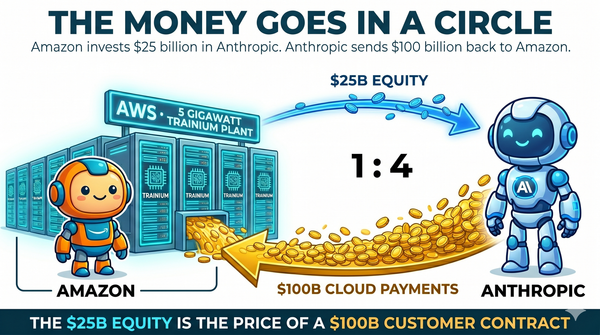
Amazon's $25 Billion Anthropic Deal Is Really A Customer Contract
Amazon committed up to $25 billion to Anthropic this week ($5 billion funded immediately, $20 billion tied to milestones). In the same deal, Anthropic committed to spend more than $100 billion on Amazon's cloud over the next 10 years. Most of the coverage is calling this an investment.
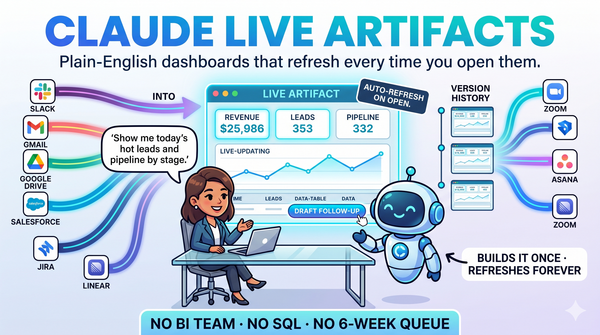
Claude Just Shipped Self-Service BI And Buried It Under A Nerdy Name
I started my sales career 20 years ago at Business Objects (which had just acquired Crystal Decisions). We sold reporting systems on top of data warehouses with massive metadata management tools and expensive dashboards that were often wrong. The dream was a system you could talk to where it could

Claude's velocity is unparalleled
Unless you live under a rock, you know that Anthropic is on a tear and Claude is currently the darling model AND stack. Here is a list of feature announcements and releases from Jan 1 2026 through to April 22, 2026. I've never seen this kind of velocity